Can You Trademark a Name with “AI” in It?

Published on November 20, 2026
Estimated Read Time: 11 minutes

Key Takeaways
- The USPTO does not automatically reject business names containing “AI.”
- Invented or distinctive wording may strengthen an AI-related name.
- Descriptive uses of “AI” may require a trademark disclaimer.
- Similar existing marks can create conflicts even without an exact name match.
- A .ai domain does not automatically establish trademark rights.
- A comprehensive search can help identify potential conflicts before filing.
Quick Answer: Yes, a business name containing “AI” can qualify for trademark registration if the complete mark is distinctive and meets USPTO requirements. However, “AI” may be descriptive for artificial intelligence products or services. The USPTO also examines potential conflicts with existing trademarks.
AI startups are launching new products, but choosing a protectable business name requires more than adding “AI” to a memorable word.
According to the USPTO's April 2026 report, the agency received 431,734 trademark application classes during the first half of fiscal year 2026, a 7% increase from the same period in 2025.
For founders, this highlights the importance of checking potential name conflicts before launch.
A name containing “AI” may qualify for registration, but descriptive wording can create challenges. Understanding USPTO requirements, trademark disclaimers, and clearance searches can help you choose a stronger business identity.
Can You Trademark a Business Name That Includes “AI”?
Yes. The USPTO does not automatically refuse trademarks containing “AI.” Instead, it examines whether the complete name identifies a particular business's goods or services.
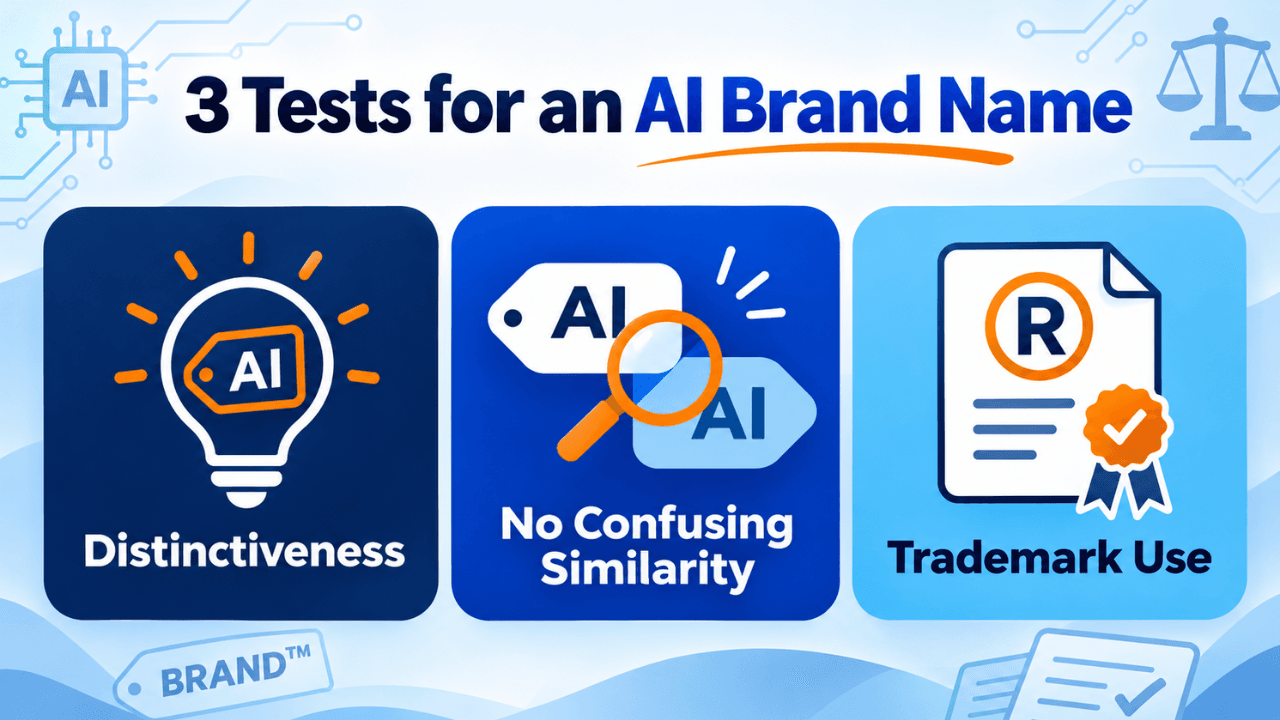
Three factors influence an AI company name trademark application:
- Distinctiveness: Does the name function as a brand rather than simply describe a product?
- Likelihood of confusion: Could consumers confuse it with an existing trademark?
- Trademark use: Does the wording identify the source of the goods or services?
For example, a hypothetical name such as “Veltrixa AI” includes an invented word that may distinguish the business. In contrast, “AI Writing Software” could directly describe the product being sold.
Neither example is automatically registrable. Each requires an assessment of the complete mark and potentially conflicting rights.
Businesses should also distinguish between names containing “AI” as a reference to artificial intelligence and names where those letters form part of an unrelated word. Consumer perception and the relevant goods or services determine how the wording is evaluated.
For additional guidance, see Trademark Engine's guide to choosing a trademarkable AI tool name.
When Is “AI” Considered Descriptive in a Trademark?
“AI” may be considered descriptive when it immediately communicates that a product or service uses artificial intelligence.
The USPTO evaluates descriptiveness in relation to the particular goods or services. The same wording may have a different meaning in another industry.
How Does Trademark Distinctiveness Affect Registration?
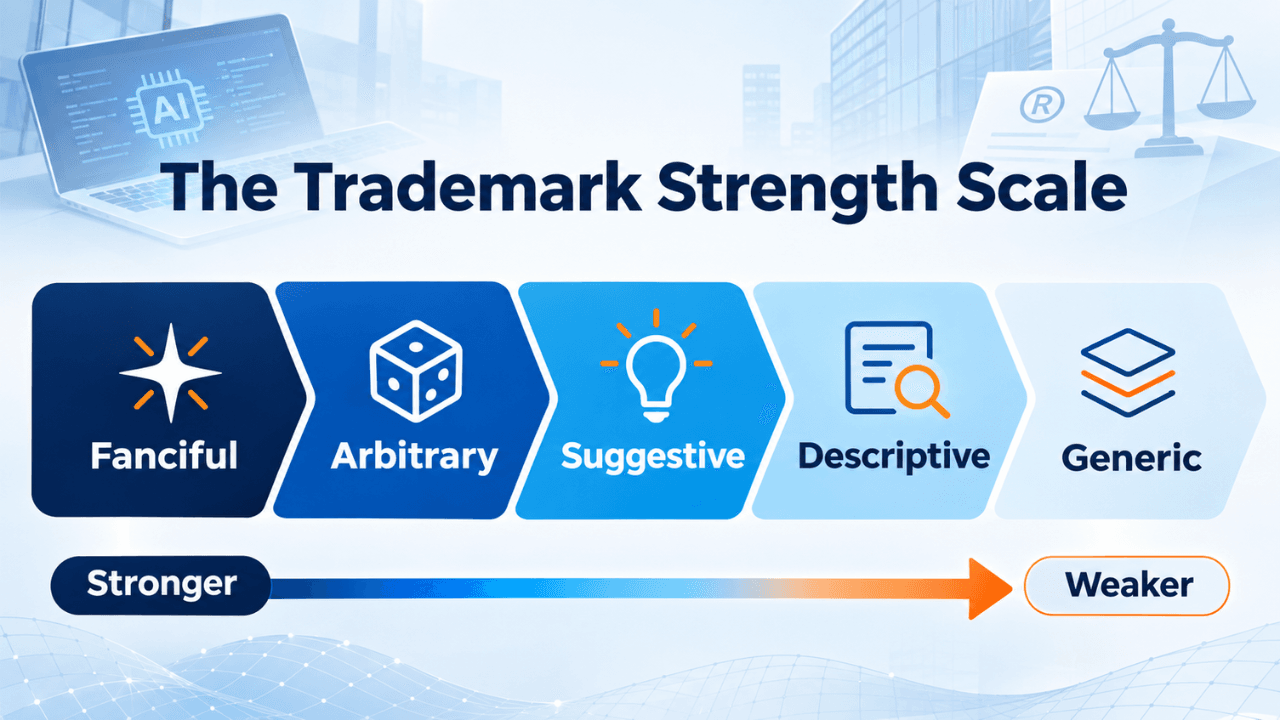
The USPTO generally evaluates marks according to their distinctiveness.
| Trademark Type | Hypothetical Example | General Assessment |
|---|---|---|
| Fanciful | Veltrixa AI | Invented wording may help distinguish the source |
| Arbitrary | Purple Harbor AI for software | Unrelated familiar words may be distinctive |
| Suggestive | BrightPath AI for analytics | Suggests a benefit without directly describing it |
| Descriptive | AI Writing Software | Directly describes the product or its function |
| Generic | Artificial Intelligence Software | Identifies the product category |
These examples illustrate trademark concepts. They are not confirmed available names or USPTO decisions.
According to the USPTO's guidance on strong trademarks, fanciful, arbitrary, and suggestive marks are generally inherently distinctive.
Descriptive marks may qualify for the Principal Register after acquiring distinctiveness through marketplace use. Certain eligible marks may also qualify for the Supplemental Register.
Generic terms cannot function as trademarks for the goods or services they name.
What Makes an AI Brand Name More Distinctive?
Before choosing a name, consider these questions:
- Does the wording identify your company rather than merely describe its technology?
- Could customers distinguish it from other AI businesses?
- Would the name remain relevant if your products expanded?
- Does it sound or look similar to another company's mark?
An invented or unexpected brand element may be a stronger starting point than a name built entirely around common industry terms.
However, distinctive wording does not guarantee availability. Existing trademark rights must still be considered.
Does the USPTO Require an AI Trademark Disclaimer?
The USPTO may require an AI trademark disclaimer when “AI” is descriptive or otherwise unregistrable as a separate element of an otherwise registrable mark.
A disclaimer means the applicant does not claim exclusive rights to a particular element apart from the complete trademark.
For example, suppose a business applies to register the hypothetical name “Veltrixa AI” for artificial intelligence software.
If the examining attorney determines that “AI” describes the technology involved, the application may require wording such as:
“No claim is made to the exclusive right to use ‘AI’ apart from the mark as shown.”
This is an illustration. A disclaimer is not automatically required for every trademark containing “AI.”
How Does a Disclaimer Affect Brand Protection?
A disclaimer does not remove the letters from the trademark or automatically prevent registration of the complete mark.
However, the registration cannot be used to claim exclusive rights to the disclaimed wording by itself.
Importantly, disclaiming “AI” does not give another business permission to use a confusingly similar complete trademark.
The USPTO's disclaimer guidance explains how disclaimers apply to particular elements within a mark.
A disclaimer cannot correct every legal problem, including an entirely generic mark or an unresolved conflict with an earlier trademark.
How Can You Check Whether an AI Brand Name Is Available?
A trademark clearance search helps identify existing names that could conflict with your proposed brand.
Checking only an exact spelling is insufficient because confusingly similar marks may have different wording or pronunciation.
Step 1: Search Federal Trademark Records
Begin with the official USPTO Trademark Search system.
Search for:
- Exact names and alternative spellings
- Similar pronunciations
- Names with and without “AI”
- Abbreviations or related word combinations
A search should also consider the goods or services connected to each potentially relevant mark.
Step 2: Compare Related Products and Services
The USPTO considers similarities in appearance, sound, meaning, and commercial impression when examining possible conflicts.
For example, suppose you want to register “Veltrixa AI” for downloadable design software.
Your search reveals a hypothetical earlier mark, “Veltrixa,” for related design software.
Adding “AI” may not sufficiently distinguish the two marks because they share the same distinctive element.
This example illustrates the factors discussed in the USPTO's likelihood of confusion guidance, not a prediction of a specific application outcome.
Step 3: Investigate Marketplace Use
Federal trademark records do not identify every business that may hold trademark rights.
Review company websites, app stores, ecommerce marketplaces, relevant business directories, and state records.
Earlier qualifying commercial use can create trademark rights even without federal registration.
Step 4: Assess Potential Conflicts
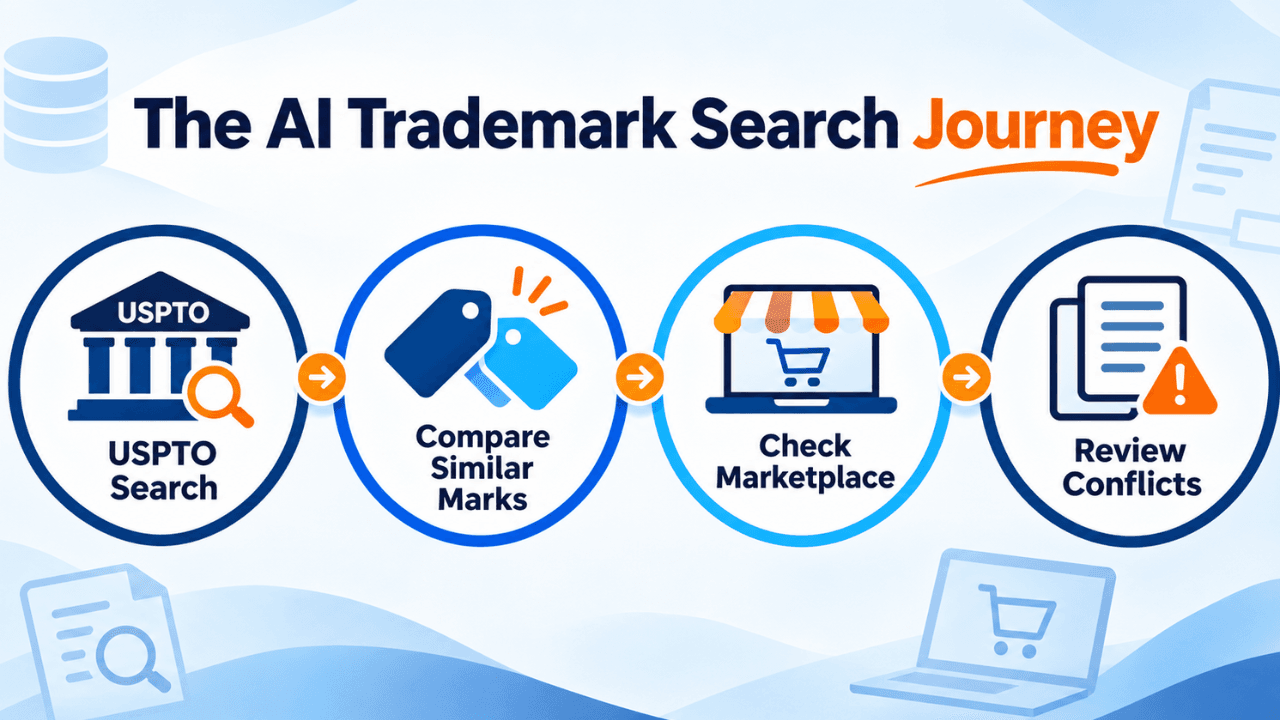
If a similar name appears, investigate the relevant goods or services, available registration records, and marketplace evidence.
A potentially conflicting result does not automatically make your proposed name unavailable. However, it may justify further research or advice from a U.S.-licensed trademark attorney.
Trademark Engine's guide to broader trademark searches explains when an exact-name search may miss important risks.
How Do You Register an AI Company Name With the USPTO?
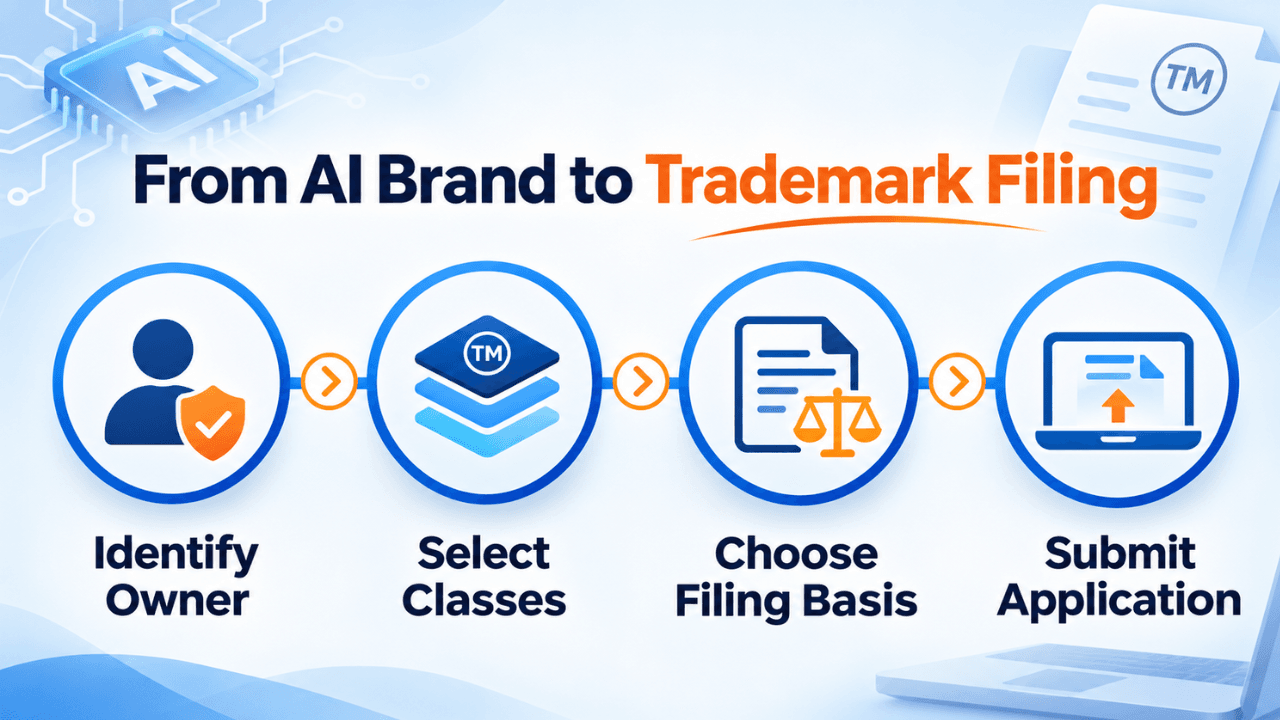
The registration process requires identifying the trademark owner, describing the relevant goods or services, selecting a filing basis, and submitting an application with the required government fees.
Choose the Appropriate Trademark Classes
There is no universal trademark class for AI businesses.
Classification depends on what your company offers, not simply whether its name includes “AI.”
| Trademark Class | Common Business Application |
|---|---|
| Class 9 | Downloadable AI software and mobile applications |
| Class 42 | SaaS and certain technology services |
| Class 35 | Certain business management and consulting services |
| Class 41 | Educational and training services |
For example, an ecommerce business using AI to recommend clothing may need trademark protection for its clothing products rather than an AI software service.
The USPTO's goods and services guidance explains why accurate classifications and descriptions matter.
Select the Correct Filing Basis
Two common filing bases are:
- Use in commerce: Your mark is already used in qualifying commerce for the listed goods or services.
- Intent to use: You have a genuine intention to use the mark commercially but have not started qualifying use.
An intent-to-use application allows eligible businesses to begin the process before launch. However, registration generally requires later proof of qualifying use and additional filings.
The USPTO's filing basis guidance explains these requirements.
Prepare Your Trademark Application
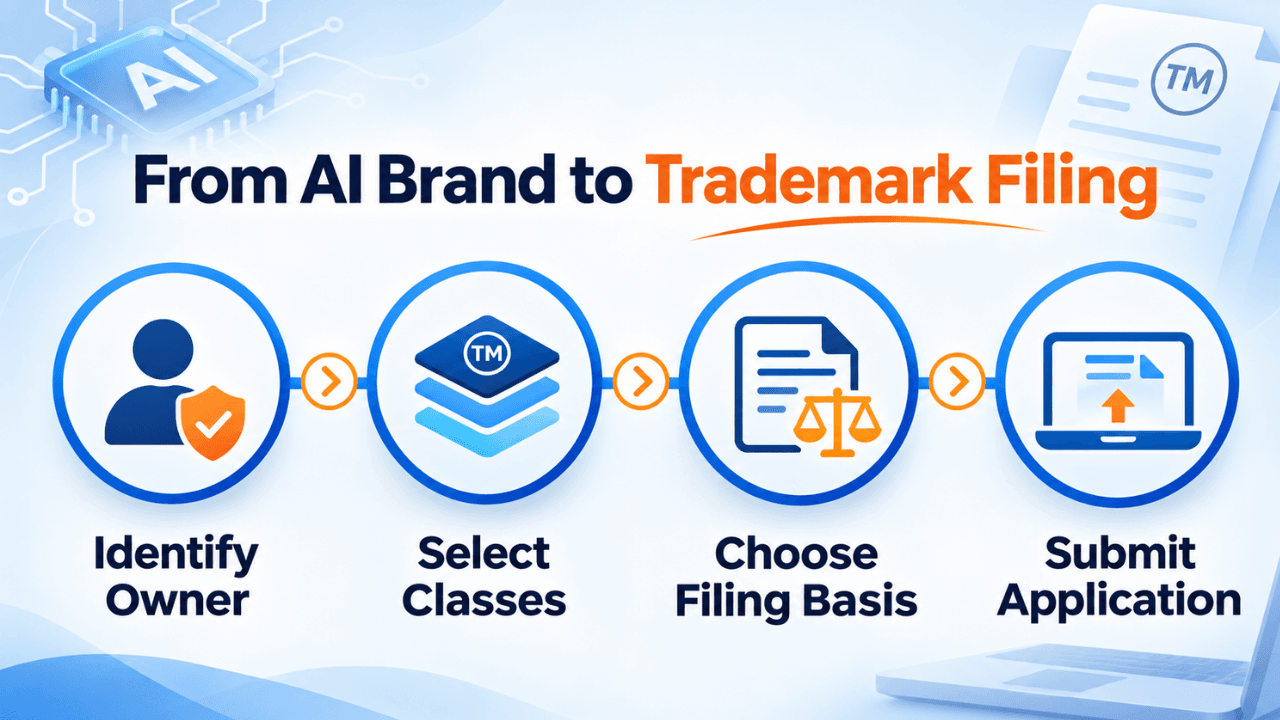
Before submitting your application through Trademark Center, verify:
- The correct legal owner and contact information.
- The exact mark you want to register.
- Accurate goods or services descriptions.
- Appropriate trademark classes and filing basis.
- Required supporting evidence, when applicable.
An examining attorney reviews the application and may issue an office action identifying questions or legal objections.
Reviewing these details beforehand can help you avoid preventable filing errors.
How Much Does Trademark Registration Cost?
Under the USPTO fee schedule in effect in November 2026, the base application fee for qualifying applications under Sections 1 and 44 is $350 per class.
For example:
- One class: $350 in base government filing fees.
- Two classes: $700 in base government filing fees.
Additional government fees may apply based on application requirements. Intent-to-use filings may also require later fees before registration.
Check the official USPTO fee schedule before applying.
Are AI-Generated Names, GPT Names, and .ai Domains Different?
Yes. These situations involve different legal considerations from using the letters “AI” in a business name.
AI-Generated Business Names
A name suggested by artificial intelligence may qualify for trademark registration if it satisfies ordinary trademark requirements.
The USPTO generally examines whether the name functions as a source identifier rather than requiring the wording to have been invented by a human.
However, AI-generated suggestions are not automatically unique or available. Businesses should still investigate potential trademark conflicts.
GPT Trademark Considerations
A name containing “GPT” may raise descriptiveness or existing-rights concerns.
Depending on consumer understanding and the goods or services, those letters may describe a technology feature.
Using another company's established branding alongside “GPT” may also create potential confusion or affiliation concerns.
.ai Domain Trademark Protection
Purchasing a .ai domain does not automatically establish trademark rights.
A domain can function as part of a brand identity when used appropriately, but registering a web address alone is insufficient.
The USPTO's trademark process guidance distinguishes domain ownership from trademark registration.
What Should AI Startups Do Before Launching Their Brand?
Before launching, confirm that your trademark plans match your business operations and intended commercial use.
Use this final checklist:
- Confirm ownership: Identify whether you or your business entity owns the mark.
- Keep evidence of use: Save genuine product pages, packaging, or relevant service materials.
- Review application details: Confirm the correct owner, mark, goods or services, and filing basis.
- Plan for expansion: Consider whether future products may require additional trademark coverage.
- Track deadlines: Monitor USPTO correspondence and future maintenance requirements.
These steps complement other startup legal requirements, including business formation, contracts, and recordkeeping.
For more guidance, review Trademark Engine's pre-filing trademark checklist.
Conclusion
A business name containing “AI” may qualify for trademark registration, but adding those letters does not guarantee protection. The USPTO considers the complete mark, its distinctiveness, and possible conflicts with existing rights.
For AI startups, choosing a recognizable name and researching its availability before launch can reduce avoidable problems. Understanding trademark disclaimers, filing requirements, and product classifications also helps you make informed decisions about protecting your business identity as it grows.
Ready to Protect Your AI Business Name?
Trademark Engine offers trademark search and registration services to help business owners explore their next steps.
Start with Trademark Engine's trademark search tools to investigate your proposed business name before filing.
Trademark Engine is a private service provider, not the USPTO. Applicable government filing fees are separate from service fees.
Trademark Engine Editorial Team
Frequently Asked Questions
Potentially. The USPTO evaluates what “AI” means to consumers in relation to the actual goods or services. If the letters do not describe the offering, they may raise different distinctiveness considerations. Misleading representations about a product's technology can create additional concerns.
A standard-character word mark protects eligible wording without limiting it to a particular font or design. A separate logo application protects the design as submitted. The appropriate choice depends on your branding priorities, budget, and how customers recognize your business.
Only certain changes are permitted. The USPTO generally prohibits material alterations that change a mark's overall commercial impression. If you substantially rename your business after filing, you may need to submit a new application.
Yes. Eligible foreign individuals and companies can seek federal trademark registration in the United States. Applicants domiciled outside the country generally must be represented before the USPTO by a U.S.-licensed attorney.
Yes. Businesses can generally use ™ for goods or SM for services when claiming trademark rights without federal registration. The ® symbol is reserved for federally registered marks and must be used appropriately for the goods or services covered by the registration.
Get Trademark Tips and Compliance Guidance
Subscribe for updates, insights, and resources that help you stay compliant and grow your mission.