What Should You Double-Check Before Submitting a Trademark Application?

Published on October 26, 2026
Estimated Read Time: 14 minutes

Key Takeaways
- An exact-name search alone cannot establish trademark availability.
- Similar trademarks may conflict even when their spelling or classes differ.
- Your trademark classes must reflect your actual goods or services.
- Incorrect ownership or filing-basis information can create serious application problems.
- A valid specimen must show genuine trademark use, not just a logo or mockup.
- USPTO filing fees start at $350 per class, with additional fees in certain cases.
Quick Answer: Before submitting a trademark application, check your name's availability, potentially conflicting marks, trademark classes, legal owner, filing basis, goods and services descriptions, and specimen requirements. Also review your trademark format, supporting details, and USPTO fees to avoid preventable filing mistakes.
A trademark application may look straightforward until you need to decide who owns the mark, which products to list, or whether your business has legally started using it.
These details matter because the United States Patent and Trademark Office (USPTO) examines more than your proposed business name. Inaccurate information can lead to refusals, additional expenses, or a new application.
For example, an ecommerce founder might select a class based on their industry rather than the products they sell. Another applicant could submit a product rendering that fails to demonstrate actual trademark use.
The following eight checks will help you review the important parts of your application before paying the filing fee.
Is Your Trademark Name Actually Available?
A trademark may conflict with an existing mark even when no identical name appears in federal search results. That's why availability involves more than checking whether your preferred wording has already been registered.
Start with the USPTO Trademark Search system, which lets you review federal registrations and pending applications.
How to Check Trademark Availability
Search for:
- Your exact proposed name.
- Alternative spellings and abbreviations.
- Similar-sounding names.
- Related terms and translations.
- Marks used with related goods or services.
You should also examine relevant state records, online stores, business websites, and other marketplace uses. Some businesses may have enforceable trademark rights without federal registration.
For example, a candle company planning to use "Cedar Glow" should investigate a similar brand called "Cedar Glo" rather than assuming different spelling means the name is available.
Also consider distinctiveness. Generic product names cannot function as trademarks for those goods, while descriptive marks may face additional registration requirements.
The USPTO explains these differences in its Strong Trademarks guide.
Practical tip: Record the closest search results, their status, and the goods or services they cover. This gives you useful information for evaluating possible conflicts.
Could a Similar Trademark Cause Customer Confusion?
Two trademarks can conflict if consumers might mistakenly believe that related products or services come from the same source.
The USPTO calls this likelihood of confusion, one of the most common reasons trademark applications are refused.
What Makes Trademarks Confusingly Similar?
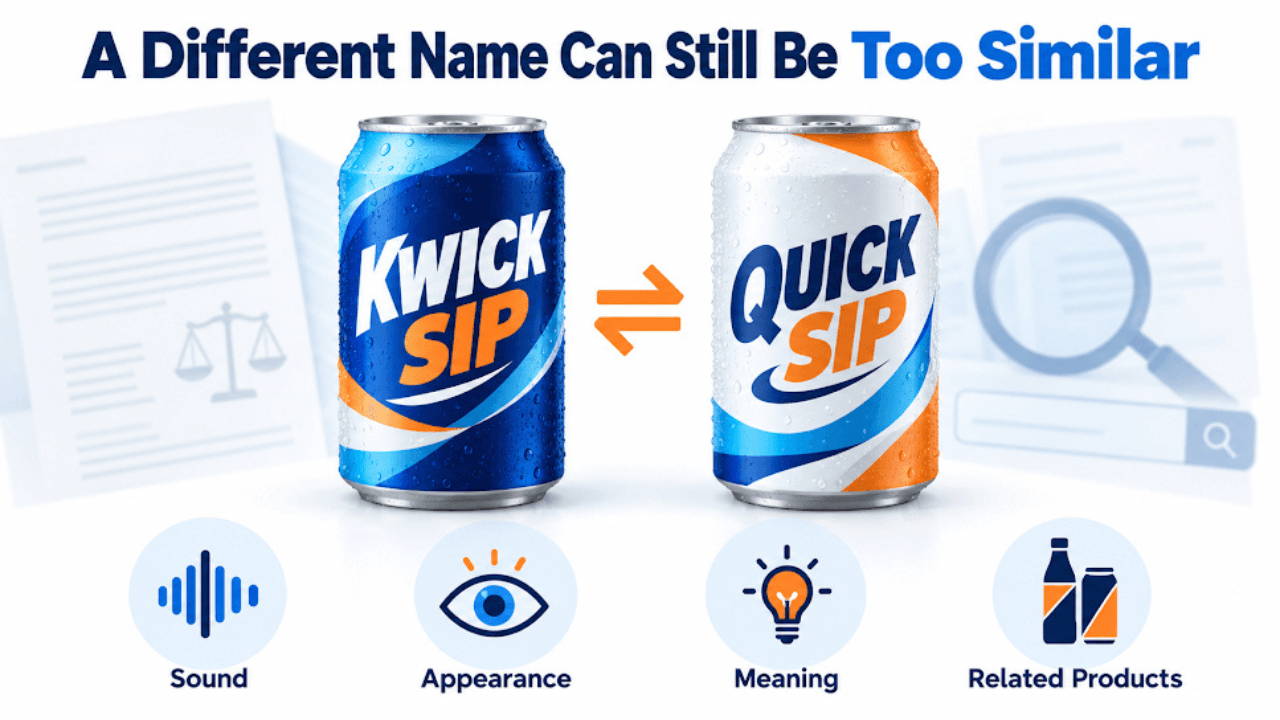
| Factor | What to Compare |
|---|---|
| Spelling | Similar letters, words, or variations |
| Pronunciation | Names that sound alike |
| Appearance | Similar visual presentation |
| Meaning | Words expressing similar ideas |
| Goods or services | Related offerings that consumers might associate |
Imagine two fictional beverage brands named "Kwick Sip" and "Quick Sip."
Although their spellings differ, customers would likely pronounce them the same way. If both businesses sell similar drinks, the resemblance could raise concerns.
A different trademark class doesn't automatically prevent a conflict. The relationship between the goods or services is often more important than their class numbers.
Review the USPTO's Likelihood of Confusion guidance to understand how examiners assess these issues.
If your search reveals a close match, consider getting legal advice before investing further in the proposed name.
Did You Select the Correct Trademark Class?
Your selected trademark classes must correspond to the goods or services listed in your application, not simply the industry in which your company operates.
The international trademark classification system has 45 classes: 34 for goods and 11 for services.
Common Trademark Classes for Small Businesses
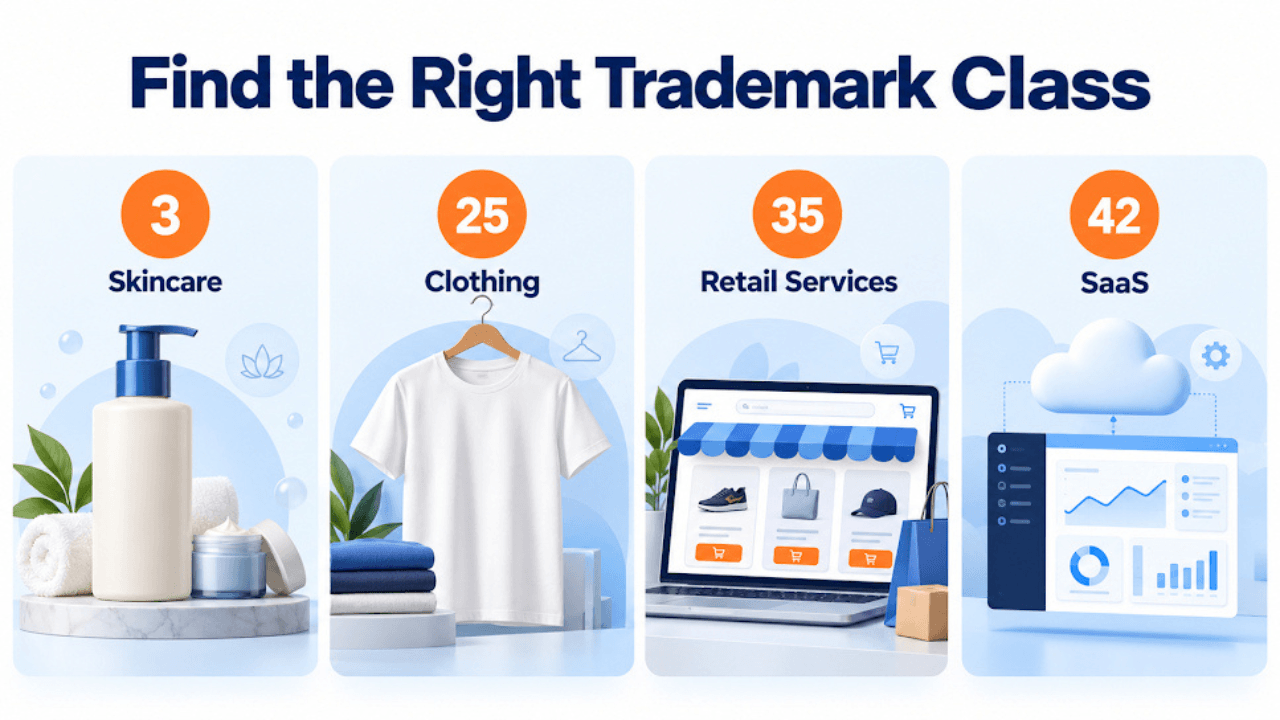
| Business Offering | Potential Class |
|---|---|
| Non-medicated skin lotions | Class 3 |
| T-shirts and sweatshirts | Class 25 |
| Online retail store services | Class 35 |
| Software as a service | Class 42 |
Consider an ecommerce brand selling its own T-shirts.
Those products generally fall under Class 25. Selling them online doesn't automatically require Class 35, which covers qualifying services such as specified retail-store services.
Businesses offering several kinds of products or services may need multiple classes.
Because the USPTO charges filing fees per class, selecting unnecessary classes can increase your expenses. Omitting relevant goods or services may also limit the scope of your application.
Use the USPTO Trademark ID Manual to identify classifications that match your offerings.
Practical tip: List your actual products and services first, then identify the appropriate classes. Don't start with a broad industry label.
Is the Trademark Owner Information Correct?
Your application must identify the person or legal entity that owns the trademark. Naming the wrong applicant can create serious problems that may not be correctable.
The owner could be an individual, LLC, corporation, partnership, or another legally recognized entity.
Individual vs. LLC: Who Should File?
Suppose you started selling products under a brand while operating as a sole proprietor. Later, you formed an LLC.
Before submitting, determine whether you still own the trademark personally or whether ownership has been properly transferred to the company.
Check:
- The owner's full legal name.
- The correct business entity type.
- The state or country of organization, when applicable.
- Any relevant ownership transfers or agreements.
- Who legally controls the trademark's use.
A minor naming error involving the actual owner may be correctable. Identifying an entirely different party is more serious.
The USPTO explains relevant restrictions in its guidance on correcting application errors.
Your domain name, store name, and LLC name may be different. Make sure the application identifies the true legal owner.
Have You Selected the Correct Trademark Filing Basis?
The correct filing basis depends on whether your trademark is already in qualifying commercial use or whether you genuinely intend to use it later.
For many U.S. applicants, the two common options are Section 1(a) and Section 1(b).
Use in Commerce — Section 1(a)
This basis applies when you're already using the mark in qualifying commerce with the identified goods or services.
You generally must provide first-use dates and an acceptable specimen demonstrating that use.
Intent to Use — Section 1(b)
This basis applies when you haven't started qualifying use but have a genuine intention to do so.
It may suit a founder developing products, arranging manufacturing, or preparing a launch.
| Requirement | Use in Commerce | Intent to Use |
|---|---|---|
| Current qualifying use | Required | Not required at filing |
| Initial specimen | Generally required | Not required |
| First-use dates initially | Required | Not required |
| Proof of use before registration | Generally included initially | Required later |
| Additional use-related filing | Not ordinarily required | Generally required |
For goods, merely displaying products on a website or accepting preorders may not establish qualifying commercial use.
Intent-to-use applicants must later demonstrate use and submit the appropriate filing before registration can issue.
The USPTO Filing Basis guide explains these requirements.
Your decision should reflect your actual business activity, not which option appears simpler on the application.
Are Your Goods and Services Described Correctly?
The goods and services description must clearly identify what you sell or provide under your trademark.
Selecting the right class is only part of the process. The description determines the particular offerings covered by your application.
Examples of Clearer Descriptions
| Too Broad | More Specific Example |
|---|---|
| Beauty products | Non-medicated skin lotions |
| Clothing | T-shirts; sweatshirts |
| Software | Downloadable inventory management software |
These examples illustrate the level of detail that may be needed. Final wording must accurately match your offerings and the USPTO's accepted terminology.
Avoid including products simply because you might introduce them someday. Even an intent-to-use applicant must have a genuine intention to use the mark with the listed goods or services.
Also, you generally cannot broaden the identification after filing. Certain changes that narrow or clarify it may be permitted.
Using acceptable wording directly from the Trademark ID Manual can help reduce classification problems and avoid the surcharge associated with free-form descriptions.
Practical tip: Compare the application against your product catalog or service list. Every item should have a legitimate connection to your business.
If Claiming Current Use, Is Your Trademark Specimen Acceptable?
An acceptable specimen must show how customers actually encounter your trademark in qualifying commerce.
A standalone logo, digital concept, or unused product rendering generally doesn't demonstrate actual trademark use.
What Can Qualify as a Trademark Specimen?
For physical goods, suitable evidence may include:
- A product label bearing the mark.
- Packaging used with products being sold.
- A hangtag attached to the goods.
- An ecommerce product page displaying the mark, the goods, and purchasing information.
For services, advertisements or website pages may qualify when they clearly connect the trademark to services actually being provided.
Why Are Mockups Often Rejected?
Imagine a skincare founder who uploads a digitally generated picture of a lotion bottle showing the proposed brand.
If the packaging has never been used with goods in qualifying commerce, the image generally won't qualify as an acceptable specimen.
A genuine product photograph or an appropriate sales webpage may work, depending on the circumstances.
For webpage specimens, the USPTO requires the webpage URL and the date accessed or printed, either on the specimen or in the appropriate filing fields.
See the USPTO Specimen Requirements for examples and submission rules.
The important question is whether the evidence documents real use of the mark with the claimed goods or services.
Have You Reviewed Issues Beyond the Basic USPTO Form?
A complete pre-filing review also covers your trademark drawing, required statements, signature, and possible legal issues that the application fields alone won't resolve.
Are You Filing a Word Mark or a Logo?
A standard-character application covers the wording without restricting it to one particular font or design.
A special-form application covers the stylized wording or design shown in the submitted drawing.
For example, a brand that frequently changes its logo may want to consider whether a standard-character application for its name better matches its objectives. The appropriate choice depends on the mark and intended protection.
Which Filing Mistakes May Require a New Application?
| Application Issue | General Rule |
|---|---|
| Incorrect contact information | Often correctable |
| Minor error identifying the actual owner | May be correctable |
| Wrong legal owner | Can make the application invalid |
| Adding broader goods or services | Generally not permitted |
| Material change to the mark | Generally not permitted |
Check your domicile information, translations or other required statements when applicable, and signing authority. Applicants domiciled outside the United States generally must use a U.S.-licensed attorney for USPTO trademark matters.
When Should You Consider Professional Review?
A qualified U.S. trademark attorney can help assess potentially conflicting marks, ownership questions, filing strategy, and specimen issues.
Professional review may be valuable when your search finds close matches or the legal ownership of your brand is unclear.
No search or review can ensure that the USPTO will approve an application, but it can help you identify concerns before filing.
How Much Does Filing a Trademark Cost in 2026?
The USPTO charges a base filing fee of $350 per class for qualifying applications under Sections 1 and 44. Additional government fees may apply based on how you file and what happens later.
| Government Fee | Amount |
|---|---|
| Base application | $350 per class |
| Insufficient information surcharge | $100 per class |
| Free-form goods/services text box surcharge | $200 per class |
| Statement of use | $150 per class |
| Six-month intent-to-use extension request | $125 per class |
A two-class application generally starts at $700 in base filing fees. Using the free-form identification text box for both classes would add $400 under the applicable surcharge rules.
Applicants should also budget for optional paid searches or professional assistance, if used.
After registration, maintenance fees apply. The USPTO currently lists $325 per class for a Section 8 declaration and $325 per class for a Section 9 renewal.
The USPTO Fee Schedule provides the current fee amounts and requirements.
Final Trademark Application Checklist
Before submitting your application, complete this final review:
- Search existing federal marks and relevant marketplace uses.
- Evaluate similar marks and related goods or services.
- Confirm the correct trademark classes and descriptions.
- Verify the applicant's legal ownership.
- Select the appropriate filing basis and provide required use information.
- Check the specimen, if your filing basis requires one.
- Review the mark drawing, statements, signature, and contact details.
- Confirm applicable fees and save copies of your supporting documents.
If you discover an issue you cannot confidently resolve, consider obtaining legal guidance before submission.
Conclusion
Submitting a trademark application requires more than choosing an available business name. Your ownership details, classifications, filing basis, descriptions, and evidence of use must accurately reflect your business.
Reviewing these requirements before payment can help you avoid preventable errors and understand where additional guidance may be needed. A careful review doesn't determine the USPTO's final decision, but it can make your filing more accurate, complete, and better prepared for examination.
Ready to Take the Next Step?
Explore Trademark Engine's comprehensive trademark search to research potential conflicts, or visit Trademark Engine to learn more about trademark registration options and applicable service and government filing fees.
Trademark Engine Editorial Team
Frequently Asked Questions
Check whether your proposed mark conflicts with existing trademarks, whether you have selected the appropriate classes, and whether the legal owner and filing basis are correct. Review your descriptions, specimen requirements, application statements, and fees before submitting.
Key mistakes include relying only on exact-name searches, identifying the wrong owner, selecting unsupported goods or services, claiming qualifying use too early, and submitting an invalid specimen. Some of these errors cannot be corrected through a simple amendment.
Compare your application with legal business records, product descriptions, use dates, and genuine evidence of commercial use. Follow USPTO guidance for each field, and consider attorney review when you are unsure about ownership, potential conflicts, or other legal requirements.
Determine whether you are already using the mark in qualifying commerce or have a genuine intention to use it later. Section 1(a) generally requires current-use evidence, while Section 1(b) requires additional proof and filing steps before registration.
Yes. A qualified U.S. trademark attorney can review search results, applicant ownership, filing basis, descriptions, and specimen evidence. Administrative trademark filing services can also help with parts of the process, but they do not necessarily provide legal advice.
Some errors, including certain contact details or minor clerical mistakes, may be corrected. However, identifying the wrong legal owner, materially changing the mark, or expanding the listed goods and services can create problems that may require a new application.
Get Trademark Tips and Compliance Guidance
Subscribe for updates, insights, and resources that help you stay compliant and grow your mission.