Year-End Trademark Checklist for Small Businesses: What to Review Before 2027

Published on November 20, 2026 | Updated on November 23, 2026
Estimated Read Time: 9 minutes

Key Takeaways
- Inventory the brand names, logos, and product names your business uses.
- Review federal registrations and pending applications for important deadlines.
- Assess whether rebranding or business expansion creates new filing needs.
- Search for potentially conflicting marks before introducing new brands.
- Confirm the correct trademark owner and preserve evidence of use.
- Prepare for the January 2027 USPTO classification update.
Quick Answer: A year-end trademark checklist helps small businesses identify upcoming USPTO deadlines, review existing brand protection, and prepare for new launches. Before 2027, check your registration records, confirm ownership and commercial use, and address any gaps that could affect your business.
Trademark activity continued to grow in 2026. According to the U.S. Patent and Trademark Office's April 2026 report, the agency received 431,734 trademark application classes during the first half of fiscal year 2026, a 7% increase over the same period in FY 2025.
For small businesses, protecting a recognizable brand requires attention beyond the initial filing. New products, changing business structures, and upcoming maintenance obligations can affect trademark records.
A year-end review provides an opportunity to identify these changes before 2027. The following checklist explains what to examine, where to verify information, and how to prioritize your next steps.
1. Conduct a Year-End Brand Audit
A year-end brand audit identifies the trademarks your business actively uses and compares them with your existing registrations or applications. It helps you understand what is protected, what remains unregistered, and which assets need attention.
Create an Inventory of Your Brand Assets
Start by listing the names and designs customers associate with your business.
Include:
- Business and trading names
- Logos and distinctive slogans
- Product and collection names
- Brands displayed on packaging
- New names planned for 2027
Focus on elements that identify the source of your goods or services. Ordinary product descriptions generally do not function as trademarks.
For example, an ecommerce business might operate under one registered store name but introduce a separate candle collection with its own branding. The new collection name may warrant an independent trademark assessment.
Verify Federal Records
Use the USPTO Trademark Search system to locate relevant applications and registrations.
Then check the Trademark Status and Document Retrieval (TSDR) system for current status, correspondence, and available documents.
A simple tracker can organize your findings:
| Brand Asset | Current Position | Review Needed |
|---|---|---|
| Business name | Registered | Ownership and registration details |
| Updated logo | Changed in 2026 | Consistency with registered mark |
| Product-line name | Unregistered | Protection options |
| Pending application | Under examination | Outstanding USPTO notices |
| Future brand | Planned for 2027 | Research before launch |
Include the registration or serial number where available. This makes future searches and recordkeeping easier.
2. Identify Trademark Deadlines for 2027
Trademark deadlines for 2027 depend on each registration's filing history and any notices issued by the USPTO. Federal trademark maintenance does not follow a universal December 31 deadline.
Review Registration Maintenance Windows
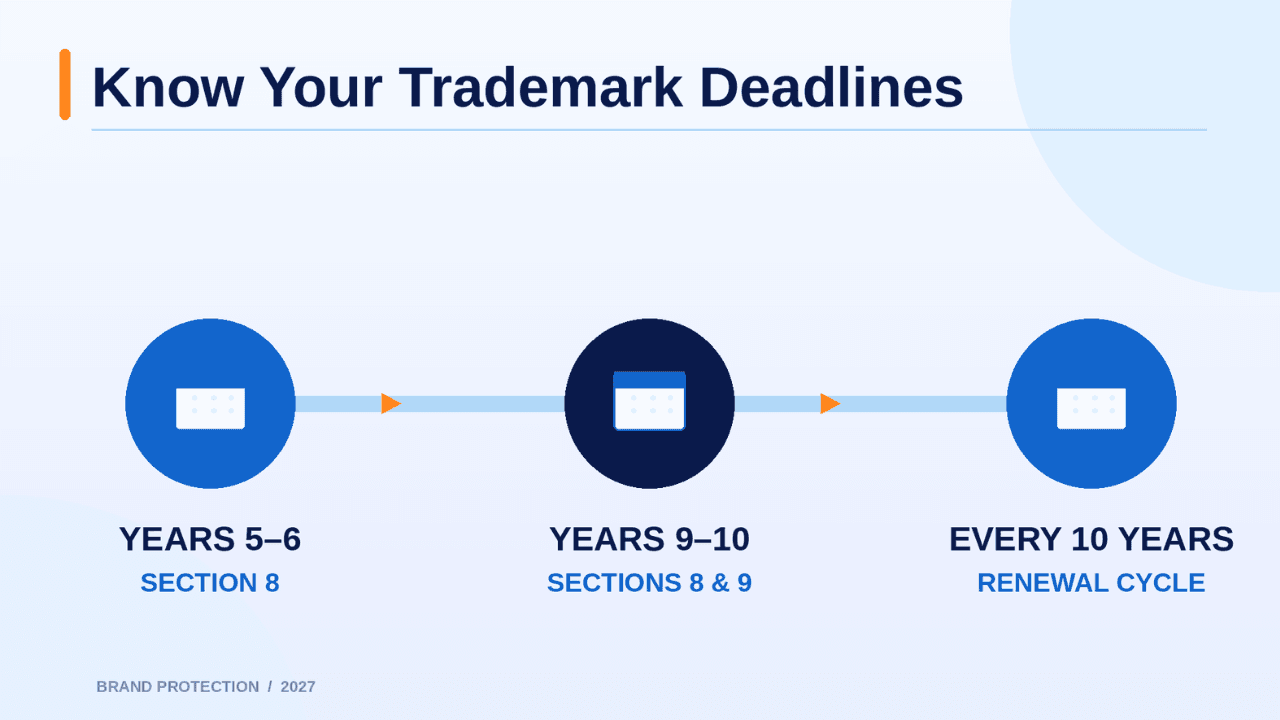
Standard federal registrations not based on the Madrid Protocol generally follow these maintenance requirements:
| Filing Period | Requirement | Purpose |
|---|---|---|
| Years 5–6 after registration | Section 8 Declaration | Confirm continued use or qualifying excusable nonuse |
| Years 9–10 after registration | Combined Sections 8 and 9 | Maintain and renew registration |
| Years 19–20, then every 10 years | Combined Sections 8 and 9 | Continue maintenance and renewal |
The USPTO generally provides a six-month grace period after these windows, with additional fees.
For example, a registration issued on July 15, 2022, enters its first Section 8 filing window on July 15, 2027.
Registrations based on the Madrid Protocol have different requirements, including Section 71 declarations.
The USPTO's maintenance guidance explains the relevant filing periods.
Check Pending Application Notices
If you have an application under examination, review whether the USPTO has requested additional information or issued a refusal.
Most Office Actions for applications under Sections 1 and 44 require a response within three months. Eligible applicants can request one additional three-month period for a fee.
Applications under Section 66(a) generally follow a six-month response period without that extension option.
Some notices have different deadlines. Check the actual document rather than assuming the standard response period applies.
See the USPTO's Office Action guidance for more information.
Practical tip: Calendar deadlines with advance reminders and assign one person to monitor correspondence.
3. Assess Rebranding and Product Expansion
Rebranding can affect how your trademark appears and which products customers associate with it. Existing federal registration does not automatically cover a substantially different mark or newly introduced goods.
Evaluate Changes to Names and Logos
A minor logo adjustment may be acceptable without a new filing. However, a material alteration that changes a trademark's commercial impression generally cannot be handled through an amendment to the existing registration.
Consider the difference:
- Small visual adjustment: May not materially change the registered design.
- Different business name: Generally requires a separate application if federal registration is sought.
- New product category: May require additional coverage for the goods or services involved.
Suppose a clothing business starts selling skincare products under its established brand. Its clothing registration does not automatically extend to skincare simply because the owner and brand name remain the same.
The business should review the goods identified in its existing registration and assess whether another application is appropriate.
Review Word Marks and Logo Coverage
A standard-character trademark registration protects wording without limiting it to a specific font, style, or design.
A special-form registration protects the particular representation shown in the registration.
Understanding this difference can help businesses decide which assets deserve attention when updating their visual identity.
For a major rebrand, assess the new mark before committing to packaging, advertisements, or website redesigns.
4. Search for Conflicts Before Launching New Brands
A trademark search helps identify existing rights that may conflict with a proposed name or logo. Searching only for an exact match can overlook similar marks associated with related products or services.
Examine Similar Names and Commercial Use
A broader clearance review should consider:
- Exact names and spelling variations.
- Similar pronunciation, appearance, and meaning.
- Registered marks and pending federal applications.
- Related goods and services.
- Relevant state records and unregistered commercial use.
For example, two skincare brands could have different spellings but similar pronunciations. That similarity may warrant further review when their products are closely related.
The USPTO's clearance search guidance explains why evaluating several sources matters.
Document Your Findings
Check relevant ecommerce marketplaces, business websites, and directories for existing brand use.
Save significant findings with the website address, product information, and date. These records can help you understand what research was completed before selecting a name.
Trademark Engine's free trademark search offers an initial way to research proposed marks. More extensive research and registration services may involve separate charges, including applicable government filing fees.
An initial search is useful, but a result showing no exact match should not be treated as confirmation that a trademark is available.
5. Prepare for the 2027 USPTO Classification Changes
The USPTO's updated Nice Classification takes effect on January 1, 2027. This change is especially relevant to small businesses preparing new federal applications.
The Nice Classification is an international framework that organizes goods and services into classes for trademark filing purposes.
In August 2026, the USPTO announced that the 13th edition, version 2027, would revise the class headings for Classes 6 and 9 to clarify the goods included in those categories.
The corresponding changes will appear in the USPTO's Trademark ID Manual when the update takes effect.
This does not mean that all existing registrations must be refiled. Instead, applicants preparing new filings should use the descriptions and classification guidance applicable at the time of filing.
Review the USPTO's 2027 classification announcement for the official details.
6. Confirm Ownership and Evidence of Trademark Use
Federal trademark records should accurately reflect the proper owner, while maintenance filings generally require evidence that the mark remains in use for the relevant goods or services.
Review Ownership After Business Changes
A merger, acquisition, or transfer of business assets may affect trademark ownership.
Confirm that:
- The recorded owner is the correct individual or legal entity.
- Relevant assignments have been documented.
- Legal name changes have been addressed appropriately.
- USPTO correspondence reaches the responsible contact.
Trademark assignments can require careful handling because transferring a mark without the associated business goodwill may create legal problems.
The USPTO's ownership and assignment guidance explains the available procedures.
Maintain Authentic Commercial Records
Evidence of actual trademark use may include qualifying labels, product packaging, or ecommerce sales pages.
For webpage specimens involving goods, the USPTO generally expects a direct association between the trademark and the products, along with appropriate purchasing information.
The webpage URL and access or print date must also be provided as required.
A digital mockup or proposed packaging design does not establish genuine use in commerce merely because it displays the mark.
See the USPTO's specimen guidance for more details.
Businesses that discontinue products should also consider whether those goods can properly remain covered in future maintenance filings.
7. Organize Your Trademark Protection Planning for 2027

Trademark protection planning for 2027 should turn your review into a manageable schedule. The most useful plan assigns each unresolved issue an owner, a priority, and a next step.
| Priority | Task | Recommended Action |
|---|---|---|
| Immediate | Outstanding USPTO notices | Respond by the stated deadline |
| Scheduled | Registration maintenance | Prepare required filings within the applicable window |
| Before launch | New names and product lines | Complete clearance and evaluate filing needs |
| Ongoing | Potential conflicts | Monitor relevant filings and marketplace activity |
Document who is responsible for each action and when it should be reviewed.
For ongoing research, Trademark Engine's trademark monitoring service can help identify potentially similar new applications. An alert signals a possible issue for assessment; it does not establish infringement.
A practical plan helps you direct attention toward the trademarks that matter most to your business.
Conclusion
A year-end trademark checklist helps small businesses prepare for 2027 with greater clarity about their brand rights and responsibilities. Reviewing registrations, application deadlines, ownership records, and planned changes can reveal gaps before they affect business decisions.
Use your findings to address time-sensitive obligations and create a manageable protection plan. A consistent review process can help your trademark strategy evolve alongside your business without adding unnecessary administrative work.
Ready to Take the Next Step?
If your review identifies a brand name, logo, or product line that may need federal protection, explore Trademark Engine's trademark registration service to learn about the filing process and available assistance.
This article provides general educational information about U.S. trademark procedures. It is not legal advice for a particular business or application.
Trademark Engine Editorial Team
Frequently Asked Questions
Yes. Certain trademark rights can arise through actual commercial use, even without federal registration. These common-law rights may offer more limited geographic protection than a federal registration.
No. The ® symbol is intended for federally registered marks and should be used only for the goods or services covered by the registration. The ™ symbol can generally indicate a claimed trademark before registration.
Not automatically. Domain registration does not establish trademark ownership by itself. Trademark rights depend on factors such as use in commerce, distinctiveness, and existing rights held by others.
Yes. An applicant with a genuine intention to use a trademark in commerce may qualify for an intent-to-use application. Under this filing basis, registration generally requires proof of qualifying use before it can issue.
No. U.S. federal registration generally provides protection within the United States and its territories. Businesses entering foreign markets should evaluate the trademark requirements of each country where they seek protection.
Sometimes. Similar marks may coexist when their use is unlikely to confuse consumers. The analysis depends on the marks, their related goods or services, and other relevant circumstances.
Get Trademark Tips and Compliance Guidance
Subscribe for updates, insights, and resources that help you stay compliant and grow your mission.