When Should You File a Trademark? A Startup Filing Timeline

Published on November 18, 2026 | Updated on November 20, 2026
Estimated Read Time: 11 minutes

Key Takeaways
- Search for conflicting marks before investing heavily in your brand.
- You can apply before launching if you genuinely intend to use the mark commercially.
- Your business stage determines whether an intent-to-use or use-based filing is appropriate.
- Early filing may establish priority benefits, subject to existing trademark rights.
- USPTO applications start at $350 per class, with possible additional fees.
- Keep track of official notices and deadlines after submitting your application.
The best time to file a trademark is generally after finalizing your brand name and checking for conflicts, but before making major launch investments. You can apply before selling through an intent-to-use application or file after qualifying commercial use begins.
When to file a trademark is an important decision for startups preparing to launch a business, product, or online store. Applying too early may create extra costs, while waiting can increase the risk of brand conflicts.
According to the U.S. Patent and Trademark Office's October 2026 announcement, average first-action processing time was 4.1 months in fiscal year 2026, while average time to final disposition was 9.5 months.
These figures show why filing should be part of your startup planning. Understanding when to apply, which filing basis to select, and what deadlines follow can help protect your brand without unnecessary complications.
When Is the Best Time to Trademark a Business Name?
The ideal time to consider filing is when you have finalized your brand name, researched potential conflicts, and developed a genuine plan to use it commercially.
You don't necessarily need completed sales or an operating business.
Before Launching Your Business
Pre-launch filing may be appropriate if your intended brand is stable and you're preparing to enter the market.
For example, you may already have:
- A finalized business or product name.
- A clearly defined product line or service.
- Supplier agreements, prototypes, or development plans.
- A realistic commercial launch strategy.
In this situation, an intent-to-use application may allow you to establish a filing date before qualifying commercial use begins.
This can be useful when you're investing in branded packaging, product development, or advertising.
After Starting Commercial Operations
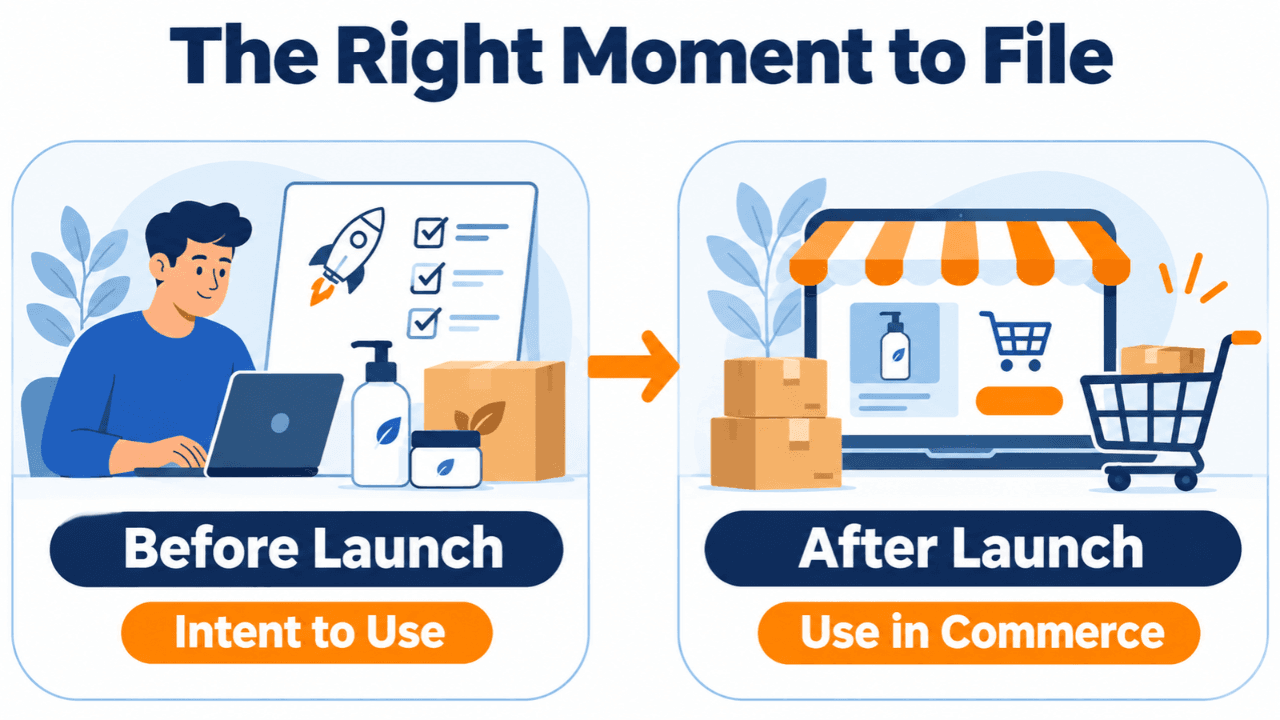
If your business already uses its mark with qualifying goods or services, a use-based application may be appropriate.
This filing basis generally avoids the later proof-of-use filing required for an intent-to-use application.
However, delaying can become problematic if another business has earlier rights to a conflicting mark.
The practical approach is to make your filing decision based on brand readiness and commercial activity, rather than waiting for a particular revenue target.
A Startup Trademark Filing Timeline: Five Key Stages
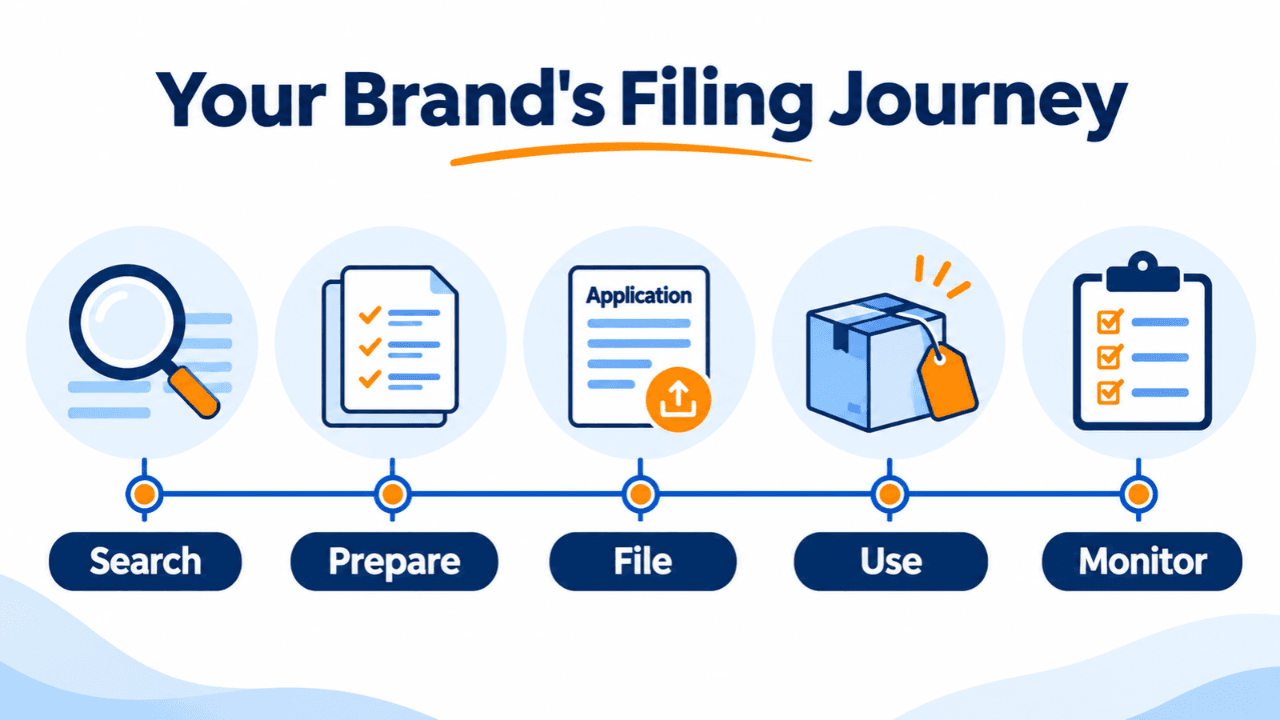
A useful trademark timeline for startups follows business milestones rather than fixed calendar dates.
The following five stages can help founders prepare for federal registration.
Stage 1: Research Potential Brand Conflicts
Timing: During business planning
Before spending heavily on packaging, advertising, or inventory, investigate whether your chosen name conflicts with existing trademarks.
Start with the USPTO's federal trademark searching guidance.
Look for identical names and marks that are similar in spelling, pronunciation, meaning, or commercial impression.
Also consider whether the businesses offer related goods or services.
For example, two skincare brands with similar-sounding names may create confusion even when their spellings differ.
Check relevant state records and existing marketplace activity because federal records do not identify every potential conflict.
Stage 2: Prepare Your Application Information
Timing: After selecting your intended brand
Once you've completed an appropriate search, organize the information needed for filing.
Identify:
- The correct trademark owner.
- The goods or services associated with the mark.
- The relevant trademark classes.
- Your intended filing basis.
- The specific name or logo you want to register.
Ownership is particularly important. An application filed by the wrong party can have defects that cannot always be corrected.
You should also decide which brand asset deserves priority.
For example, a company selling several products under one main brand may benefit from prioritizing its business name over an individual product label.
For further guidance, explore whether to trademark a brand name or product name first.
Stage 3: Submit an Appropriate Application
Timing: Before launch or after qualifying use begins
Once your brand plans are clear, select the filing basis that matches your circumstances.
An intent-to-use application may suit a startup developing products that have not yet entered the market.
A use-based application may suit a business already making qualifying commercial use of its mark.
An earlier federal filing can establish an important priority date if the mark eventually registers. However, it does not automatically override earlier trademark rights held by other businesses.
Stage 4: Document Qualifying Trademark Use
Timing: When commercial use begins
Keep evidence showing how your trademark appears in the marketplace.
For goods, acceptable evidence may include product labels, packaging, or qualifying online sales pages.
For example, an ecommerce product page may qualify when it displays the mark with the goods, provides a way to purchase them, and reflects actual commercial use.
A coming-soon page or digital product mockup generally does not establish qualifying use.
For services, suitable advertising may qualify when the services are actually being provided in commerce.
Review the USPTO's specimen requirements before submitting evidence.
Stage 5: Monitor Examination and Official Notices
Timing: After filing
Submitting an application starts the review process. It does not automatically result in registration.
A USPTO examining attorney reviews the application and may issue an Office Action identifying legal or procedural problems.
Eligible marks generally proceed to publication, where third parties have 30 days to oppose registration or request additional time to oppose.
The application may then proceed toward registration or require further use-related documents.
Follow official instructions and monitor your application status to avoid missed deadlines.
Intent to Use vs. Use in Commerce: Which Filing Basis Should You Choose?
The main difference is whether qualifying commercial use has already begun.
Under U.S. trademark law, Section 1(a) applies to existing qualifying use, while Section 1(b) allows filing based on a genuine intention to use the mark in commerce.
| Factor | Intent to Use — 1(b) | Use in Commerce — 1(a) |
|---|---|---|
| Typical business stage | Preparing to launch | Already using the mark commercially |
| Use required when filing | No | Yes |
| Initial specimen required | No | Yes |
| Additional proof-of-use filing | Generally required before registration | Generally unnecessary before initial registration |
| Additional use-related fee | Yes | Generally no |
| Startup example | Product under development | Operating online store |
How Early Can Founders Apply?
There is no universal rule requiring startups to apply a certain number of months before opening.
An intent-to-use application requires a bona fide, or genuine, intention to use the mark commercially.
For instance, a founder preparing a skincare brand may have product specifications, supplier discussions, and a documented launch plan supporting that intention.
Simply wanting to reserve an attractive name without genuine commercial plans is not sufficient.
What Happens After a Notice of Allowance?
When an intent-to-use application receives a Notice of Allowance, the applicant generally has six months to submit a Statement of Use or request an extension.
Up to five six-month extensions may be available if the requirements are met.
The maximum period is generally 36 months from the Notice of Allowance date, not from the original application date.
If qualifying use begins earlier in the process, an Amendment to Allege Use may be available at the appropriate stage.
Read the USPTO's intent-to-use application guidance for the complete filing requirements.
How Much Does Trademark Filing Cost for a Startup?
The USPTO's base application fee is $350 per class for qualifying Section 1 applications.
Your total expenses depend on the filing basis, number of classes, and whether additional documents or extensions are needed.
| USPTO Filing Activity | Government Fee |
|---|---|
| Base trademark application | $350 per class |
| Amendment to Allege Use | $150 per class |
| Statement of Use | $150 per class |
| Six-month Statement of Use extension | $125 per class |
Example: One-Class Application Costs
Consider two startups applying in one class.
- Startup A already has qualifying commercial use. Its use-based application would start at $350 in USPTO fees if it meets the base application requirements.
- Startup B has not launched. Its intent-to-use application would also start at $350.
A later Statement of Use would add $150, making the total $500 without extensions or other charges.
If Startup B needs one six-month extension, the example increases to $625.
Additional fees may apply for missing required information or certain custom descriptions of goods and services.
These amounts exclude optional professional assistance and third-party service charges.
Budgeting tip: Include potential post-filing costs when comparing filing options, especially if your launch schedule may change.
Five Trademark Filing Mistakes Startups Should Avoid
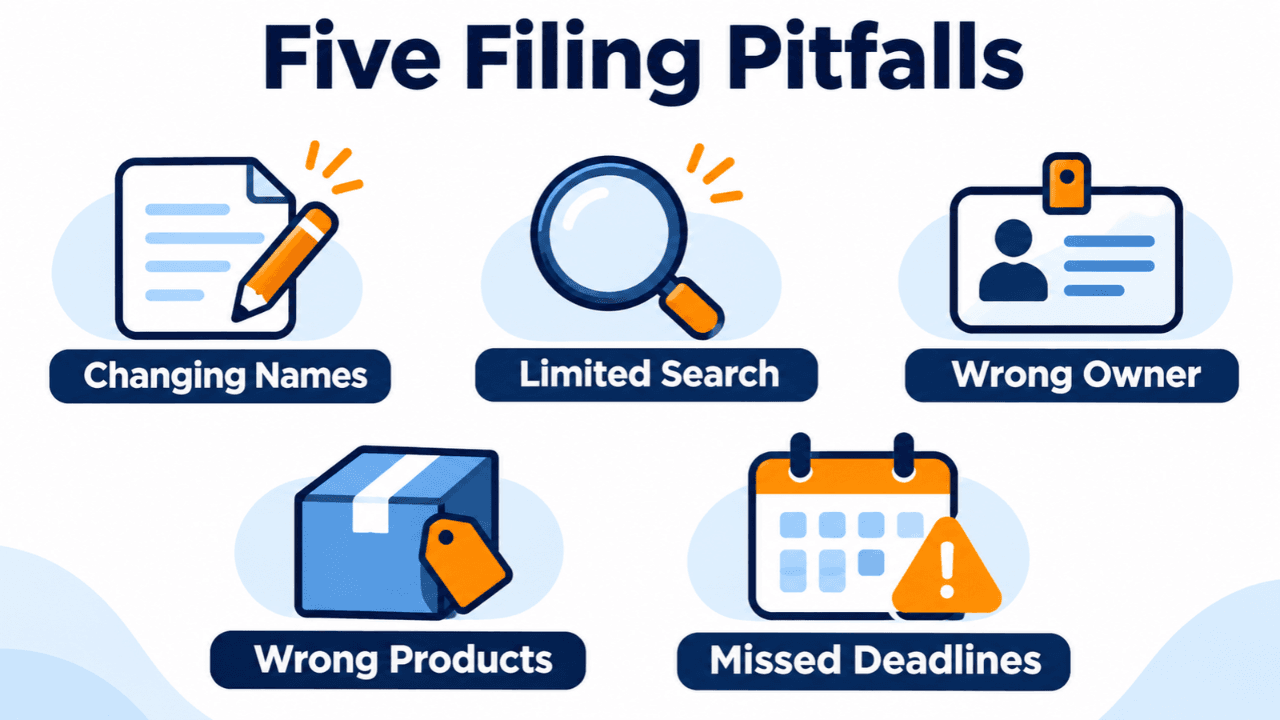
Trademark timing problems often arise from incomplete research, incorrect application details, or unsupported claims about commercial use.
Here are five mistakes worth avoiding.
1. Filing While Your Brand Name Is Uncertain
Substantial changes to an applied-for trademark may require a new application.
If you're still testing different names, finalize your brand identity before investing in registration.
2. Relying Only on a Domain or LLC Search
Domain availability and state business-name approval do not establish federal trademark availability.
Businesses may have relevant rights even without a federal registration.
A broader clearance search helps identify potential issues before launch.
3. Identifying the Wrong Trademark Owner
An individual or business entity may own a trademark, depending on the circumstances.
The application must identify the correct owner.
Some ownership errors cannot be corrected through a simple amendment and may affect application validity.
4. Filing for Products You Do Not Intend to Offer
An intent-to-use application requires a genuine commercial intention for the identified goods or services.
Avoid listing unrelated categories merely because you may expand your business someday.
Your application should reflect realistic plans.
5. Missing Application Response Deadlines
The USPTO may request clarifications or issue refusals that require a response.
Missing an applicable deadline can lead to abandonment.
Review official communications and take action within the required period.
How an Ecommerce Founder Can Plan the Launch
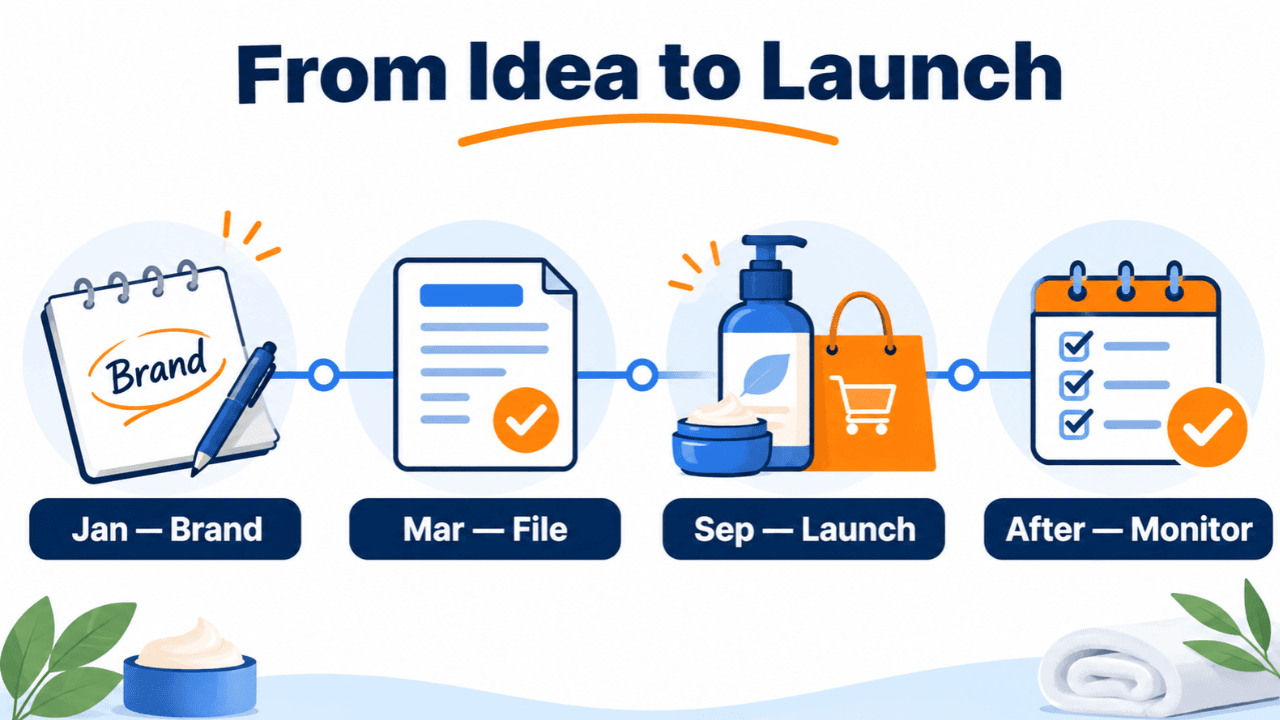
Consider a fictional skincare startup named EverMira.
Its founder chooses the brand name in January and plans to begin selling products in September.
The following example shows how trademark planning may fit the company's launch schedule.
| Business Milestone | Potential Trademark Action |
|---|---|
| January: Select EverMira | Research conflicting marks |
| February: Finalize products | Identify owner, classes, and filing basis |
| March: Prepare packaging | Consider an intent-to-use application |
| September: Begin qualifying sales | Collect acceptable evidence of use |
| Following months | Monitor USPTO examination and filing deadlines |
Suppose the founder files in March but delays the product launch until November.
The original intent-to-use application does not require proof of commercial use at filing.
Once qualifying sales begin, the founder can document how the mark appears on products, packaging, or appropriate online sales pages.
However, that evidence must be submitted at the proper stage of the application process.
If the USPTO issues a Notice of Allowance before the startup establishes qualifying use, the founder must meet the Statement of Use deadline or request an available extension.
The key lesson: Your commercial launch schedule and USPTO deadlines may not align. Tracking both separately helps avoid unnecessary complications.
Conclusion
The right time to file a trademark depends on your brand's readiness, commercial activity, and long-term plans. An intent-to-use application may suit founders preparing to launch, while use-based filing may fit businesses already operating in commerce.
Start with a meaningful clearance search, choose the appropriate filing basis, and plan for government fees and deadlines. These steps can reduce avoidable complications and support stronger brand protection as your business grows.
Ready to Protect Your Business Name?
Before investing further in your brand, explore Trademark Engine's comprehensive trademark search to identify potentially similar marks and better understand possible conflicts.
If you're ready to proceed, Trademark Engine's trademark registration services can help you navigate the application process.
Service fees and applicable USPTO filing fees are separate. The USPTO determines whether a mark qualifies for registration.
Trademark Engine Editorial Team
Frequently Asked Questions
Yes. You can apply through an intent-to-use application before opening if you genuinely intend to use the mark in commerce. You must generally establish qualifying use and satisfy additional USPTO requirements before registration.
No. Individuals and eligible business entities can apply for federal trademark registration. However, the application must identify the correct trademark owner. LLC formation and trademark registration are separate legal processes.
Yes. You can generally use ™ to indicate a claim of trademark rights without obtaining federal registration. The ® symbol is reserved for federally registered marks and should only be used for covered goods or services.
You can apply for a combined name-and-design mark in one application. However, separate protection for a standard-character name and a distinct logo generally requires separate applications. Your choice depends on the protection you need.
Yes, certain trademark applications can be assigned to another eligible owner. However, special restrictions apply to intent-to-use applications before the required use filing, including limits on assignments that are not part of a qualifying business transfer. Review the circumstances before transferring ownership.
A federal trademark registration can remain active indefinitely if the owner continues meeting the required use and maintenance obligations. Owners generally must submit maintenance documents between the fifth and sixth years after registration, followed by later required filings.
Get Trademark Tips and Compliance Guidance
Subscribe for updates, insights, and resources that help you stay compliant and grow your mission.