What Happens When a Website Ignores a DMCA Takedown Notice?

Published on October 22, 2026
Estimated Read Time: 11 minutes
Key Takeaways
- Ignoring a valid DMCA notice may put an eligible service provider's safe harbor protection at risk.
- Copyright owners can escalate unresolved complaints to hosting providers or search engines.
- The law requires qualifying providers to act expeditiously but sets no universal initial removal deadline.
- An unanswered complaint does not automatically establish copyright infringement or result in penalties.
- A valid counter-notification may lead to content restoration unless qualifying legal action prevents it.
- Original files, ownership records, and notice correspondence can help support copyright enforcement.
Quick Answer: When a website ignores a DMCA takedown notice, the reported content may remain online. An eligible service provider could lose certain legal protections if it fails to act as required. Copyright owners can contact the hosting provider, request search-result removal, or consider legal action.
You discover that another website has copied your original product photographs, blog content, or marketing graphics. You submit a copyright complaint, but the material stays online, and your messages go unanswered.
For small business owners, this can be especially concerning when copied content appears on competing websites or ecommerce stores.
The Digital Millennium Copyright Act (DMCA) provides a process for reporting alleged copyright infringement to online service providers. However, sending a notice does not guarantee immediate removal.
What happens next depends on the recipient, the validity of your complaint, and who controls the reported material.
This guide explains the possible legal consequences, realistic response timelines, and practical steps you can take when a website fails to address your notice.
What Happens After a DMCA Takedown Notice Is Sent?
After a copyright owner submits a DMCA notice, the receiving service provider may review the complaint and remove or disable access to the reported material. The process depends on the provider's role and whether the notice meets legal requirements.
Under Section 512 of the Copyright Act, eligible online service providers may qualify for limitations on liability for copyright infringement by meeting specific conditions.
How Does the DMCA Takedown Process Work?
The process generally involves five steps:
- Notice Submission: The copyright owner identifies the protected work and allegedly infringing material.
- Complaint Review: The provider checks the notice and locates the reported content.
- Content Removal: The provider removes or disables access when appropriate.
- Uploader Notification: The person who posted the content receives notice when the statutory process requires it.
- Possible Dispute: The uploader may submit a counter-notification if they believe the removal was mistaken.
A notice sent directly to a website owner is different from one submitted to the designated DMCA agent of a hosting provider.
This distinction matters because Section 512's safe harbor requirements apply to qualifying online service providers, not automatically to every website owner.
What Are the Legal Consequences of Ignoring a DMCA Notice?
Ignoring a valid complaint can affect a service provider's legal protections. It may also lead the copyright owner to consider infringement claims against the party responsible for the unauthorized use.
Loss of DMCA Safe Harbor Protection
Safe harbor is a legal protection that limits certain copyright infringement liabilities for eligible online service providers.
Under 17 U.S.C. § 512, providers covered by relevant safe harbor provisions must meet specific conditions, including acting expeditiously to remove or disable access to infringing material when required.
Failure to meet those conditions may put the applicable protection at risk.
However, losing safe harbor does not automatically establish copyright infringement. A copyright owner must still prove the elements of a valid claim.
Potential Copyright Infringement Liability
When unauthorized copying continues, copyright owners may consider legal action.
Depending on the circumstances, available remedies can include:
- Court orders stopping infringing activity.
- Compensation for proven financial losses.
- Recovery of certain profits attributable to infringement.
- Statutory damages when legal requirements are satisfied.
Under 17 U.S.C. § 504, statutory damages generally range from $750 to $30,000 per infringed work in eligible cases. Courts may award up to $150,000 per work for proven willful infringement.
These are potential remedies for copyright infringement, not automatic fines for failing to answer a DMCA notice.
Registration requirements and timing may also affect the remedies available.
For further information, explore Trademark Engine's guide to copyright infringement protection.
Platform Restrictions for Repeat Infringement
Some online platforms may restrict or terminate accounts that repeatedly publish infringing material.
Qualifying providers must adopt and reasonably implement policies addressing repeat infringers in appropriate circumstances.
However, the action a platform takes depends on its policies and the facts of the case. A single complaint does not automatically result in website suspension.
Who Receives the Notice Matters
| Recipient | Possible Consequence | Recommended Action |
|---|---|---|
| Website owner | Potential liability if infringement is established | Preserve evidence and evaluate enforcement options |
| Eligible hosting provider | Possible loss of applicable safe harbor protection | Contact its designated DMCA agent |
| Search engine | Reported links may remain searchable | Submit a copyright removal request |
| Overseas provider | Different laws or enforcement procedures may apply | Identify the jurisdiction and available remedies |
Understanding who controls the disputed content can help you direct your complaint more effectively.
What Can You Do If a Website Does Not Respond to a DMCA Notice?
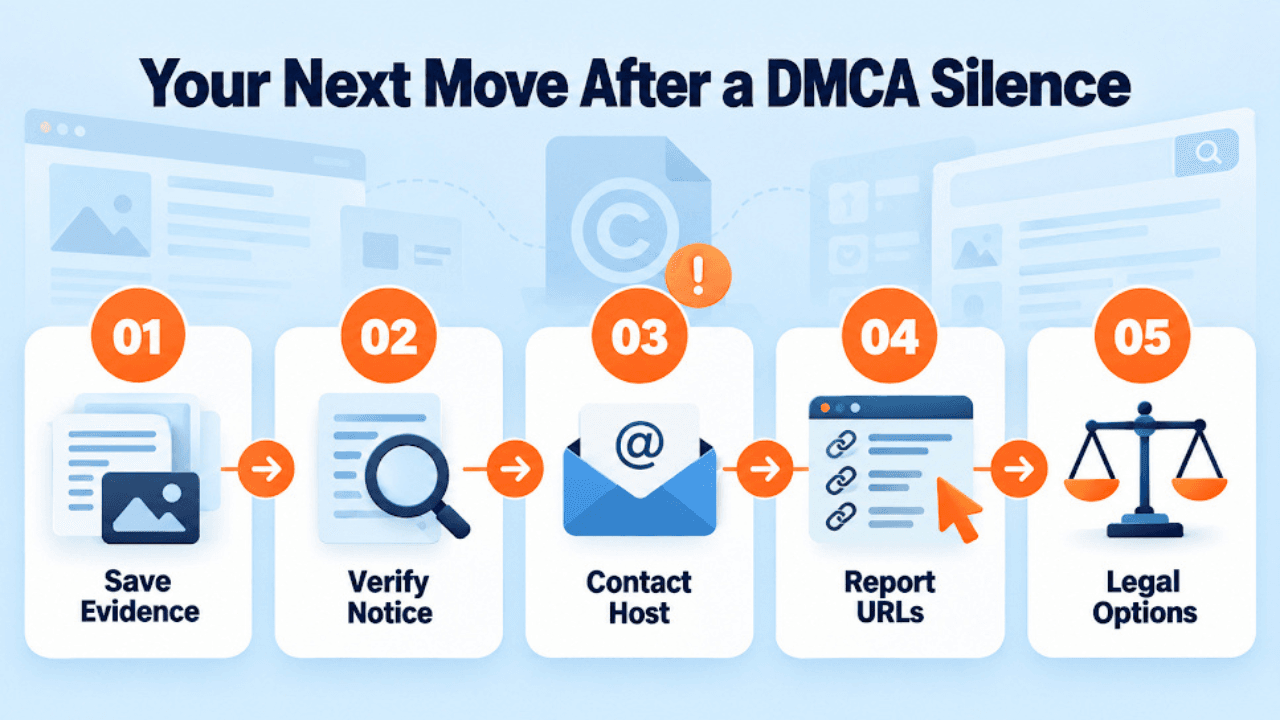
If a website ignores your request, check that your notice is complete and reaches the appropriate service provider. Then document the infringement and consider further reporting or legal options if necessary.
Step 1: Preserve Evidence of the Infringement
Before taking any further action, collect records documenting your original work and the location of the disputed material.
Keep:
- Original images, documents, videos, or design files.
- URLs of the allegedly infringing material.
- Screenshots of the relevant webpages.
- Creation and publication records.
- Copies of submitted notices and responses.
For example, suppose another ecommerce store uses photographs created for your product listings.
Save the original files, any photography agreements, and screenshots of the other store's listings.
Confirm that you own or control the relevant copyright. Hiring a photographer does not always transfer copyright ownership automatically.
Step 2: Check Whether Your Notice Meets Legal Requirements
An incomplete complaint may not provide sufficient information for a service provider to identify the disputed material.
Under Section 512(c)(3), an effective notice generally includes:
- A physical or electronic signature.
- Identification of the copyrighted work.
- Information sufficient to locate the allegedly infringing material.
- Contact information.
- A good-faith statement that the use is unauthorized by the owner, an agent, or the law.
- A statement concerning accuracy and authority, made under penalty of perjury.
Provide specific page URLs whenever possible.
You should also consider whether the use may be licensed or otherwise legally permitted.
Step 3: Contact the Hosting Provider
If the website operator does not respond, identify the provider responsible for hosting the reported material.
Check its copyright policy and designated DMCA contact.
The U.S. Copyright Office's DMCA Agent Directory can help you locate registered service providers and their designated agents.
Submit your complaint through the appropriate channel and retain confirmation of delivery.
A domain registrar, hosting provider, and content delivery network may serve different functions. They do not necessarily have equal control over removing website content.
Step 4: Request Removal From Search Results
When disputed content continues appearing in search results, you may submit a copyright removal request through the search engine's legal reporting process.
If accepted, the request may remove specific URLs from its results.
However, removing a search result does not delete the original content.
The webpage may remain accessible through direct links or other websites. Search-result removal is therefore a separate option from seeking removal at the source.
Step 5: Consider Legal Action When Necessary
If the dispute remains unresolved, a U.S. copyright attorney can help assess ownership, registration, jurisdiction, defenses, and potential remedies.
For qualifying smaller disputes, the Copyright Claims Board offers a voluntary alternative to federal court. It can handle eligible claims involving up to $30,000 in total.
Consider the financial impact of the infringement and the likely cost of enforcement before choosing a legal route.
How Long Does a Website Have to Respond to a DMCA Takedown Notice?
The DMCA does not require every website to respond within a fixed number of hours or days.
Instead, eligible service providers must act expeditiously in circumstances covered by the relevant safe harbor provisions.
The time needed to process a complaint can vary based on the provider and the completeness of the notice.
DMCA Takedown Notice Timeline
| Stage | Timing or Requirement |
|---|---|
| Copyright owner submits notice | After identifying potentially infringing material |
| Provider reviews complaint | No universal fixed deadline |
| Qualifying provider takes action | Expeditiously, when applicable under Section 512 |
| Uploader submits counter-notification | After removal, if they believe it was mistaken |
| Provider may restore material | Generally 10–14 business days after a valid counter-notification, unless qualifying court action prevents restoration |
Important: The 10–14-business-day period concerns restoration after a counter-notification. It is not the deadline for the original takedown request.
Why Do Some DMCA Takedown Requests Fail?
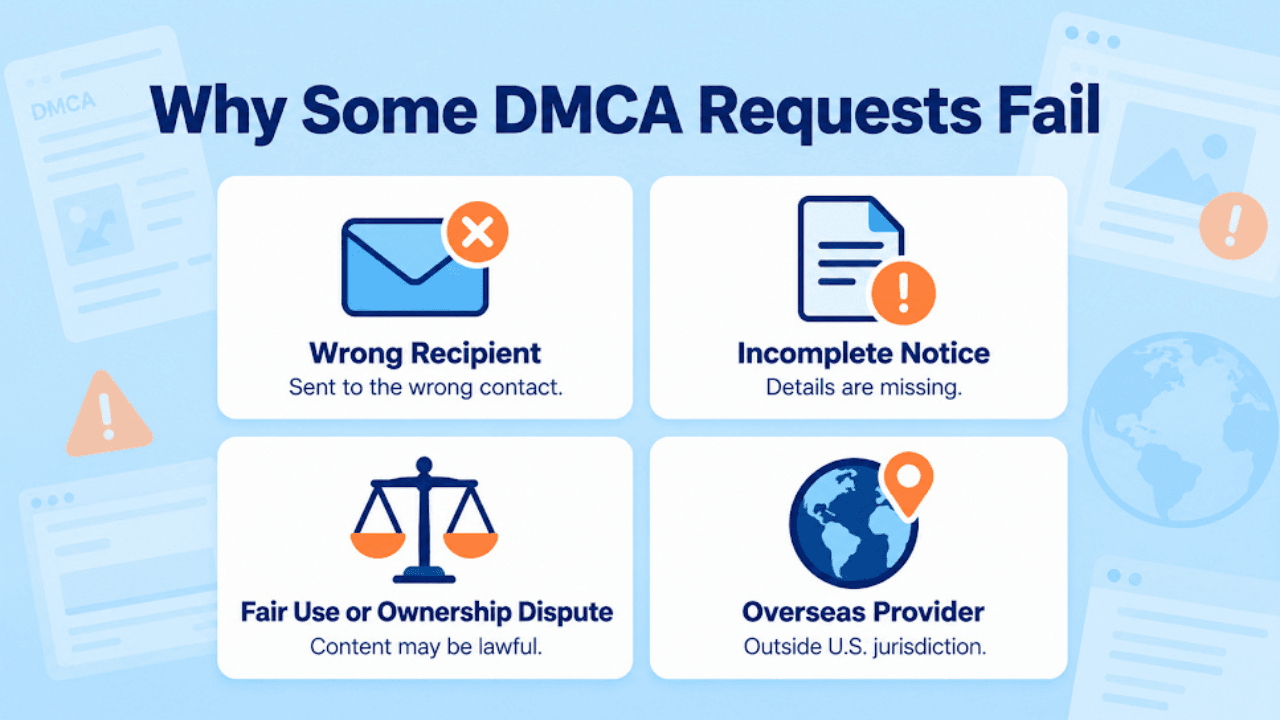
Some notices fail because they reach the wrong recipient, lack sufficient information, or concern content that may be legally permitted. Others involve disputes over ownership or enforcement across national borders.
Incorrect Recipient or Incomplete Notice
A website's general contact email may not reach its copyright team or hosting provider.
Similarly, a complaint that does not clearly identify the original work and disputed content may be difficult to process.
Using the correct reporting channel and including specific URLs can reduce these problems.
Copyright Ownership or Fair Use Disputes
A website may dispute your complaint if it believes the content was licensed, independently created, or protected by fair use.
Under 17 U.S.C. § 107, courts evaluate four factors when considering fair use:
- Purpose and character of the use.
- Nature of the copyrighted work.
- Amount and significance of the portion used.
- Effect on the potential market or value of the original.
Fair use depends on the circumstances. There is no fixed percentage that automatically makes copying lawful.
Learn more in Trademark Engine's guide to fair use in copyright.
Content Reappears or the Provider Operates Overseas
Material may reappear after removal because someone uploads another copy or successfully submits a counter-notification.
A website operating outside the United States can also present jurisdictional challenges.
Since the DMCA is U.S. federal law, foreign legal systems and the provider's location may affect enforcement options.
Can a Website Challenge a DMCA Takedown Notice?
Yes. A person whose content was removed may submit a counter-notification if they believe the removal resulted from a mistake or misidentification.
A compliant counter-notification must contain specific identifying information and legal statements.
Under Section 512(g), the provider generally must restore access between 10 and 14 business days after receiving a valid counter-notification unless it receives notice that the copyright owner has filed a qualifying court action.
The counter-notification process helps protect users against wrongful takedowns.
Knowingly making material misrepresentations in either a takedown notice or counter-notification may also create liability under Section 512(f).
How Can Small Businesses Protect Their Original Content?
Businesses can make copyright enforcement easier by maintaining ownership records, keeping clear agreements with creators, and documenting their original work.
A practical checklist includes:
- Save original creative files and project records.
- Keep written copyright assignments and licenses.
- Record when important content was created or published.
- Periodically check for unauthorized copies.
- Consider copyright registration for valuable creative assets.
Copyright generally arises automatically when an original work is created and fixed in a tangible form. Registration can provide important additional enforcement benefits.
Trademark Engine's article on copyright protection for websites provides further guidance.
Conclusion
When a website ignores a DMCA takedown notice, the next step depends on who received the complaint and why the content remains online. Review your notice, preserve evidence, and contact the appropriate service provider. If the issue remains unresolved, consider removing the search results or seeking legal advice. Understanding your options helps you address potential copyright infringement without relying on misleading deadlines, assuming automatic penalties, or taking unnecessary steps.
Protect Your Brand With Trademark Engine
Your original content is only one part of your business identity. Your business name, logo, and other eligible brand identifiers may also benefit from federal trademark protection.
Trademark Engine offers trademark search and registration tools to help you explore potential conflicts and take steps toward protecting your brand.
Trademark Engine Editorial Team
Frequently Asked Questions
Receiving a notice does not automatically establish infringement. However, an eligible service provider that fails to meet applicable DMCA requirements may lose certain liability protections. The legal consequences depend on the recipient's role and the circumstances.
Review the notice, preserve evidence, and contact the hosting provider through its designated reporting channel. If necessary, consider search-result removal or legal advice about further enforcement.
There is no universal statutory deadline for initial removal. Qualifying providers must act expeditiously when applicable legal requirements are met. Processing times depend on the provider and circumstances.
Yes. An uploader may submit a valid counter-notification. The provider generally restores the content within the statutory 10–14-business-day period unless qualifying legal action prevents restoration.
Yes. Copyright registration is not required to submit a takedown notice. However, registration requirements can affect copyright litigation and the availability of certain remedies.
The DMCA does not impose a government filing fee simply to send a takedown notice. However, hiring an attorney, registering a copyright, or pursuing litigation may involve additional costs.
Get Trademark Tips and Compliance Guidance
Subscribe for updates, insights, and resources that help you stay compliant and grow your mission.