What Does Copyright Reserved Mean? “All Rights Reserved” Explained

Key Takeaways
- Copyright can arise automatically when an eligible original work is created and fixed in a tangible form.
- “All Rights Reserved” communicates an ownership position but does not provide extra rights.
- A copyright notice is generally optional for modern U.S. works.
- Copyright ownership, notice, and registration are separate concepts.
- Permission, licensing, fair use, or another exception may allow some uses of protected content.
- Copyright protects creative expression, while trademark law can protect source-identifying names, logos, and slogans.
Quick Answer: What does copyright reserved mean? “All Rights Reserved” tells readers that a copyright owner intends to retain the rights provided by copyright law rather than broadly allowing unrestricted use. The phrase itself does not create copyright or prove that a work has been registered.
If you run a U.S. business, you may see “© 2026. All Rights Reserved.” on websites, photographs, software, packaging, and marketing materials. According to the latest U.S. Copyright Office annual report available in 2026, the Office recorded 415,780 copyright registrations in FY 2025, including 169,098 literary registrations and 79,712 visual-arts registrations.
Yet registration, ownership, and copyright notices are different concepts. This guide explains what the familiar phrase means, whether you need it, how copyright works, when content may be reused, and how copyright differs from trademark protection.
What Does Copyright Reserved Mean?
The copyright reserved meaning is that the copyright owner is signaling an intention to keep the legal rights attached to eligible creative work.
For example, an ecommerce company might place this notice in its website footer:
© 2026 Example Brand LLC. All Rights Reserved.
The wording tells visitors that the business is claiming copyright in eligible material and has not generally released that material for unrestricted copying or reuse.
However, “copyright reserved” is not a special copyright status. Copyright does not begin because someone types those words.
The U.S. Copyright Office explains that copyright generally exists automatically when an original work of authorship is fixed in a tangible medium, such as a photograph, saved document, recorded video, or digital illustration.
What Does “All Rights Reserved” Mean?
The all rights reserved meaning is essentially: “The owner is retaining the copyright rights provided by law.”
Depending on the type of work, copyright owners may hold rights relating to:
- Reproducing the work
- Preparing derivative works
- Distributing copies
- Publicly performing certain works
- Publicly displaying certain works
- Authorizing others to exercise those rights
Those rights come from copyright law, especially 17 U.S.C. §106. The phrase “All Rights Reserved” does not expand them.
| What the Notice Can Communicate | What It Does Not Automatically Prove |
|---|---|
| Copyright is being claimed | That the notice created copyright |
| Rights are being retained | That the copyright is registered |
| Permission may be required for reuse | That every possible use is prohibited |
| The work is not being openly released for unrestricted use | That the person displaying the notice has established ownership in court |
| Users should consider copyright before copying | That fair use or another exception can never apply |
How Does Copyright Work?
Copyright generally protects eligible original expression from the moment it is fixed in a tangible medium. Registration is not what initially creates that protection.
Understanding how does copyright work becomes much easier when you separate ownership, notice, and registration.
Copyright Ownership
Original business content may qualify for copyright protection when it contains sufficient original authorship and is fixed.
For a small business, examples can include:
- Original product photographs
- Website articles
- Advertising videos
- Illustrations and graphics
- Packaging artwork
- Software code
- Training materials
- Original downloadable guides
Copyright protects the expression of an idea, not the underlying idea, method, system, or concept itself. The Copyright Office also explains that names, titles, slogans, and short phrases generally do not qualify for copyright protection.
Copyright Notice
A copyright notice gives the public useful information about an ownership claim.
For visually perceptible works, 17 U.S.C. §401 identifies three basic notice elements:
- The © symbol, the word “Copyright,” or an accepted abbreviation
- The year of first publication
- The name of the copyright owner
“All Rights Reserved” may be added, but it is not one of those three statutory elements.
Copyright Registration
Registration creates an official record with the U.S. Copyright Office.
The Office explains that registration is not mandatory simply to have copyright protection. For U.S. works, however, registration or refusal is generally required before bringing an infringement lawsuit in federal court, and timely registration can affect access to statutory damages and attorney's fees.
A useful way to remember the difference is:
Creation and fixation → copyright may arise
Notice → informs the public
Registration → creates an official federal record and can provide enforcement benefits
Is All Rights Reserved Legally Required?
No. “All Rights Reserved” is not generally required to secure copyright protection for modern U.S. works.
The U.S. Copyright Office states that copyright notice is optional for works first published on or after March 1, 1989.
That means an eligible photograph does not lose modern copyright protection merely because the photographer forgot to place “©” or “All Rights Reserved” beside it.
Likewise, adding the phrase to material that does not qualify for copyright does not make that material copyrightable.
Why Use A Copyright Notice If It Is Optional?
A notice can still be useful because it makes your ownership claim easier for the public to understand.
A clear notice may:
- Alert users that copyright is claimed
- Identify the claimed copyright owner
- Show the relevant publication year
- Help users identify whom to contact for permission
- Limit certain innocent-infringement arguments in appropriate circumstances
The Copyright Office therefore identifies practical legal advantages to using a notice even where the law does not require one.
Can You Use Content Marked “All Rights Reserved”?
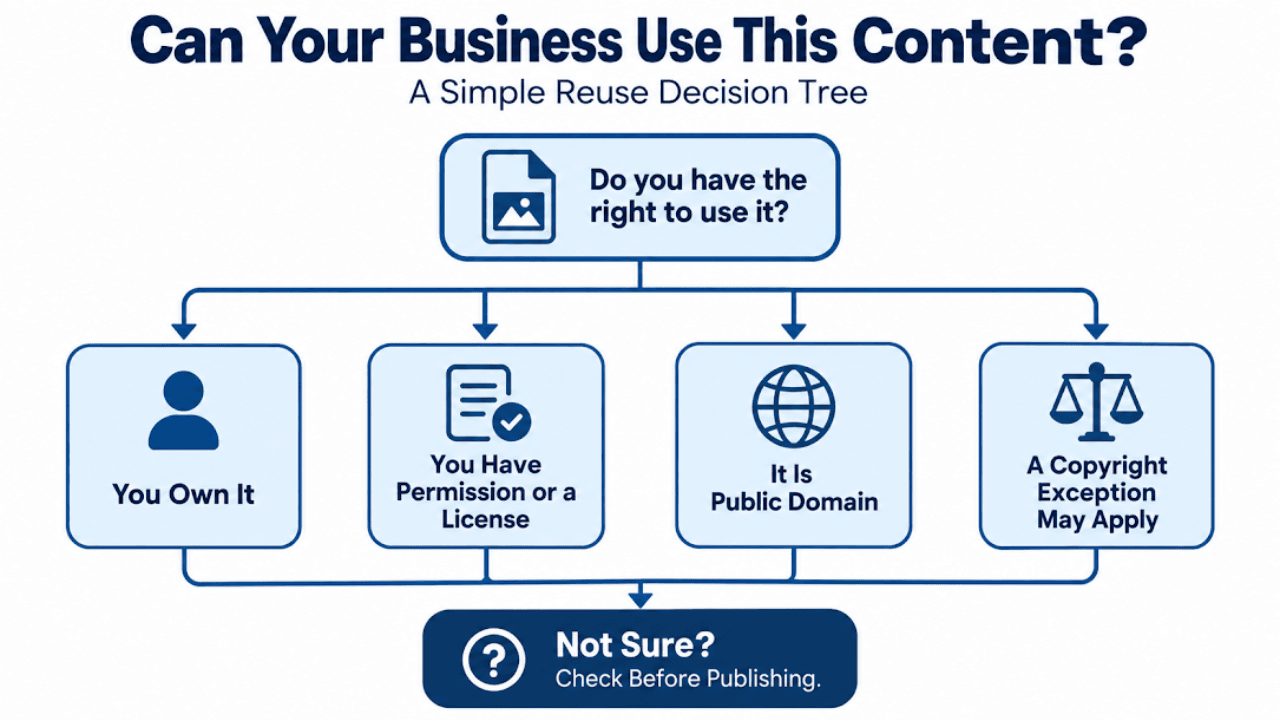
Sometimes, but you should not assume that content is free to reuse simply because you can see or access it online.
The right to use a work can depend on permission, a licence, the public-domain status of the work, or a copyright limitation or exception.
Permission And Licensing
A copyright owner can authorize someone else to use a work.
For example, a manufacturer may give an ecommerce seller permission to use product photography. A photographer may license certain images for advertising. A designer may transfer specified rights through a written agreement.
Always check what the licence actually allows.
For a business, ask:
- Who created the content?
- Who currently owns the relevant rights?
- Do we have written permission or a licence?
- Does that licence cover this specific use?
- Are there limits on platform, geography, duration, or advertising use?
This simple review can prevent confusion when your marketing team works with stock images, supplier materials, freelancers, customer content, or outside agencies.
Fair Use And Other Exceptions
Fair use can allow certain uses of copyrighted material without permission, but it depends on the circumstances.
Section 107 identifies four factors courts consider: the purpose and character of the use, the nature of the copyrighted work, the amount used, and the effect on the potential market. There is no universal “10% rule,” word count, or number of seconds that automatically makes a use fair.
Does Giving Credit Make The Use Legal?
Credit alone does not automatically give you permission.
Writing “photo by…” or tagging a creator may provide attribution, but attribution and authorization are different concepts. Before using third-party content commercially, identify the legal basis that permits the use.
What Happens If You Violate Copyright Reserved?
You do not technically violate the words “All Rights Reserved.” The legal issue is whether your use infringes copyright.
Unauthorized reproduction, distribution, display, performance, or creation of derivative works may amount to infringement when an exclusive right applies and no licence, permission, or legal exception covers the use.
Civil remedies can vary based on the facts. Copyright owners may seek remedies such as injunctions, actual damages and attributable profits, or statutory damages where the legal requirements are met.
Under 17 U.S.C. §504, statutory damages ordinarily range from $750 to $30,000 per work when available. A court may increase the amount up to $150,000 per work where willful infringement is proven. These figures are not automatic penalties, and registration timing affects eligibility for statutory damages and attorney's fees.
For a business, a practical content-use checklist is more useful than focusing only on penalties:
- Keep licence records
- Save creator or supplier permissions
- Check usage limits before launching ads
- Record where stock assets came from
- Confirm contractor agreements address ownership
- Review questionable content before publishing
Copyright Vs. Trademark: What Should A Business Protect?
Copyright generally protects original creative expression, while trademarks identify the source of goods or services.
The USPTO explains that copyright can cover original works such as photographs, software, music, and other artistic or literary works. A trademark can be a word, phrase, symbol, design, or combination that identifies and distinguishes the source of goods or services.
| Business Asset | Protection to Consider |
|---|---|
| Original product photography | Copyright |
| Original website articles | Copyright |
| Advertising videos | Copyright |
| Original graphics or illustrations | Copyright |
| Business or brand name | Trademark |
| Product-line name | Trademark |
| Source-identifying slogan | Trademark |
| Logo | Trademark and potentially copyright, depending on the artwork |
For example, the original artwork in a detailed logo may potentially qualify for copyright protection, while the same logo may function as a trademark when customers use it to identify the source of goods or services.
If you're protecting a business name, logo, slogan, or product brand, Trademark Engine's trademark search tool can help you check for existing marks before deciding whether to file.
For a more detailed conflict review, you can also explore a comprehensive trademark search.
How Should A Business Write A Copyright Notice?
A basic copyright notice can be short: © 2026 Example Brand LLC.
If you prefer, you can add the traditional wording:
© 2026 Example Brand LLC. All Rights Reserved.
For a published work, the Copyright Act generally identifies the copyright symbol or accepted wording, the year of first publication, and the copyright owner's name as the core elements of a notice.
Before placing a company name in the notice, check ownership. Your website may contain work created by employees, contractors, agencies, customers, licensors, or suppliers.
A useful internal check is:
- Identify the work
- Confirm who created it
- Review contracts or assignments
- Confirm who owns the relevant copyright
- Use an accurate notice
The notice should reflect a real ownership claim, not simply function as decorative footer text.
Conclusion
Understanding what does copyright reserved mean helps you read copyright notices correctly. “All Rights Reserved” signals that an owner intends to retain copyright rights, but the phrase does not create copyright or replace registration. For businesses, the practical goal is to know which content you own, document permission for third-party material, and distinguish creative-work protection from trademark protection for your brand.
Protect Your Brand With Trademark Engine
Copyright and trademark protect different business assets. If your next priority is a distinctive business name, product name, slogan, or logo, you can explore Trademark Engine's trademark registration service to learn about the federal filing process and your next steps.
Trademark Engine Editorial Team
Frequently Asked Questions
“Copyright reserved” generally refers to an owner retaining the rights provided by copyright law. It is not a separate category of copyright, registration status, or additional legal protection.
Yes. A copyright notice generally does not require registration with the U.S. Copyright Office. Copyright may arise automatically when eligible original expression is fixed in a tangible medium.
It generally communicates a copyright claim associated with the named owner and publication year. The © symbol, year of first publication, and owner's name form the standard notice elements; “All Rights Reserved” is optional wording.
Not automatically. Attribution does not itself grant permission. Your use may instead depend on a licence, the copyright owner's authorization, public-domain status, or a legal exception such as fair use.
No. Copyright notice is generally optional for works first published on or after March 1, 1989. Using a notice can still provide practical and legal benefits.
No. Copyright protects eligible original creative expression. Trademark law protects source-identifying words, phrases, symbols, designs, or combinations used with goods or services.
Get Trademark Tips and Compliance Guidance
Subscribe for updates, insights, and resources that help you stay compliant and grow your mission.