Trademark Suspension Letter vs. Office Action: What's the Difference?

Published on October 21, 2026
Estimated Read Time: 10 minutes

Key Takeaways
- A trademark suspension generally pauses examination without ending the application.
- An Office Action identifies issues that may prevent registration unless properly addressed.
- Earlier-filed potentially conflicting trademarks are a common reason for suspension.
- An ordinary suspension letter generally does not require a response, but a suspension inquiry does.
- Most Office Actions involving Sections 1 and 44 applications have a three-month response period, with an extension available in eligible cases.
- Checking the actual USPTO notice and application records helps determine your next steps.
Quick Answer: A trademark suspension letter means the USPTO has temporarily paused examination while another issue remains unresolved. An Office Action identifies a legal refusal or application requirement that may need a response. The main difference is whether you must act now or monitor the matter causing the delay.
The U.S. trademark registration process involves several stages, and not every application moves directly from filing to approval.
According to USPTO trademark processing data updated October 1, 2026, the average time from filing to the first examining action is 4.3 months. Actual processing times vary, and some applications experience additional delays.
Two notices that often create confusion are trademark suspension letters and Office Actions.
Although both can affect an application's progress, they serve different purposes. One may signal that the examining attorney is waiting for another matter, while the other identifies an issue requiring attention.
Understanding these distinctions can help you manage deadlines, evaluate potential trademark conflicts, and make informed decisions about your application.
Key Differences at a Glance
The most important distinction between a trademark suspension letter and an Office Action is what the USPTO expects the applicant to do next.
A suspension generally means examination must wait for another matter to develop. An Office Action means the USPTO has identified an issue with your application.
| Question | Suspension Letter | Office Action |
|---|---|---|
| What does it mean? | Examination is temporarily paused | An examiner has identified a refusal or requirement |
| Is the application rejected? | No, not merely because it is suspended | Not automatically |
| Is a response required? | Generally not for an ordinary suspension letter | Generally yes |
| What commonly causes it? | Earlier-filed potentially conflicting application | Likelihood of confusion, descriptiveness, specimen or application issue |
| What is the deadline? | Depends on the specific notice | Usually three months for Sections 1 and 44 |
| What should you do? | Identify and monitor the unresolved matter | Review and address the stated issues |
The comparison applies to ordinary examination suspensions. Other USPTO suspension procedures, including certain administrative investigations, may involve different requirements.
What Is A Trademark Suspension Letter?
A trademark suspension letter is an official USPTO communication stating that examination of an application has been placed on hold.
The examining attorney may need to wait for another application, registration, proceeding, or document before deciding whether the mark can proceed toward registration.
During an ordinary suspension, the application generally remains pending.
A suspension does not automatically mean that the examiner has refused the mark or that the applicant must submit a new application.
For more detail on this status, see Trademark Engine's guide to what “suspended” means on a trademark application.
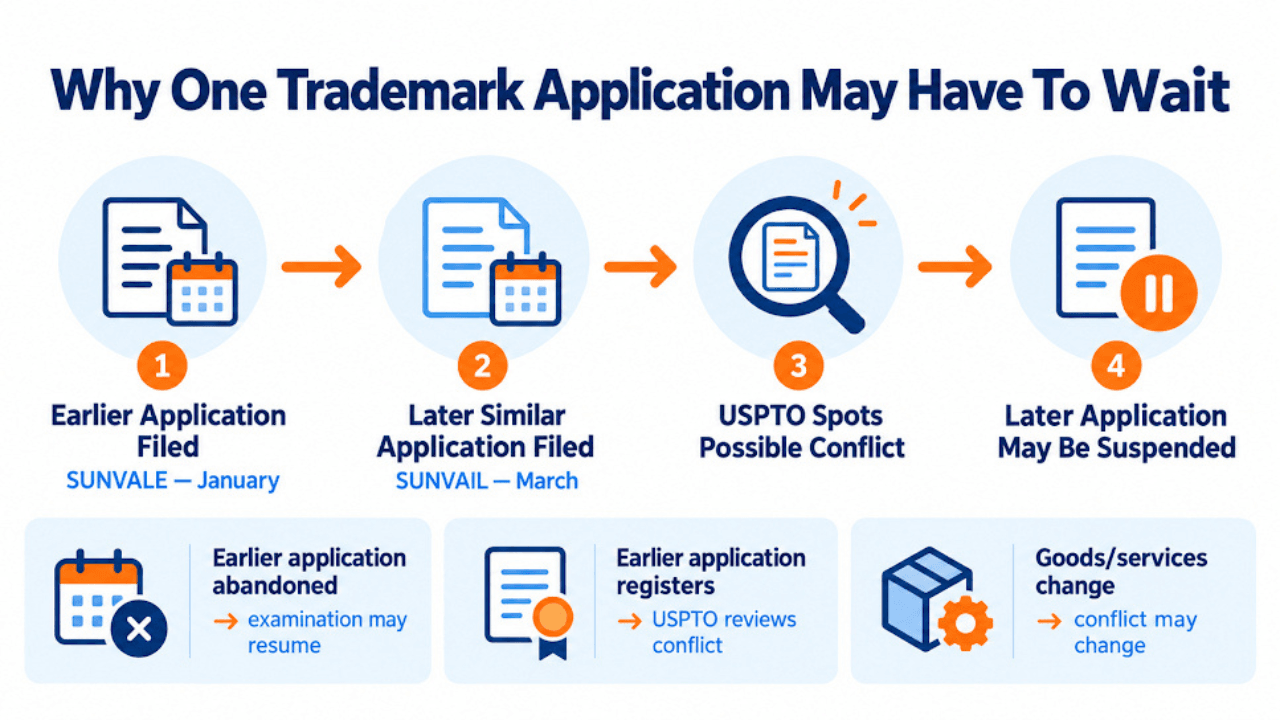
An earlier-filed potentially conflicting trademark application is one common reason.
Example:
Imagine a company files an application for SUNVALE covering skincare products in January.
In March, another business applies to register SUNVAIL for related skincare products.
Because the names are similar and the products are related, the examining attorney may need to consider whether the earlier application creates a potential conflict.
Rather than immediately resolving that question, the USPTO may suspend examination of the later-filed application while the earlier case develops.
The possible outcomes include:
| Earlier Application Outcome | Possible Effect on the Suspended Application |
|---|---|
| Remains pending | Suspension may continue |
| Becomes abandoned | Examination may be able to resume |
| Proceeds to registration | The examiner may evaluate a likelihood-of-confusion refusal |
| Narrows its goods or services | The potential conflict may change |
Other suspension reasons can involve pending legal proceedings, unresolved foreign-registration matters, or circumstances in which the USPTO needs additional information.
For example, certain U.S. applications based on foreign registrations may remain suspended while the applicant waits for the required foreign registration documentation.
The reason stated in your actual suspension notice determines what happens next.
How Long Can a Trademark Application Remain Suspended?
There is no single fixed period for every suspension.
The duration depends on the matter causing the delay. An earlier-filed application may take additional time to register, become abandoned, or resolve outstanding issues.
A suspension can therefore continue beyond ordinary examination timelines.
The USPTO's general processing averages should not be treated as predictions of when a suspended application will resume.
Applicants should monitor both their own records and, when relevant, the status of the earlier application causing the suspension.
What Is A Trademark Office Action?
A trademark Office Action is an official notice in which a USPTO examining attorney identifies a legal refusal, procedural deficiency, or application requirement.
Some issues involve relatively straightforward corrections. Others concern whether the proposed trademark qualifies for federal registration.
Common reasons include:
- Likelihood of confusion: The proposed mark may conflict with an existing registered mark.
- Descriptiveness: The wording may directly describe a feature of the goods or services.
- Specimen problems: Submitted evidence may not demonstrate qualifying trademark use.
- Disclaimer requirements: Certain wording may need to be disclaimed apart from the mark.
- Goods or services issues: The application description may be unclear or improperly classified.
- Missing information: Required statements, details, or other application materials may be incomplete.
An Office Action does not always mean the application will fail.
Some requirements can be resolved by correcting information or submitting suitable evidence. Substantive refusals may require legal arguments, supporting documentation, or consideration of other available options.
Nonfinal And Final Office Actions
The USPTO commonly issues nonfinal and final Office Actions during examination.
| Nonfinal Office Action | Final Office Action |
|---|---|
| Usually presents an initial refusal or requirement | Maintains an issue that has not been resolved |
| Applicants can submit a response addressing the issues | Applicants may need to consider reconsideration or appeal options |
| Amendments, clarification, or legal arguments may be appropriate | Remaining legal issues may require more formal action |
A final Office Action is not necessarily the end of the application.
Depending on the circumstances, applicants may request reconsideration, appeal certain refusals to the Trademark Trial and Appeal Board (TTAB), or pursue other available procedures.
The correct response depends on the issues raised and the applicable deadline.
The USPTO's Office Action guidance explains available response procedures.
Suspension Letter Vs. Suspension Inquiry
A suspension letter and a suspension inquiry are different types of USPTO communications.
A suspension letter generally announces a pause. A suspension inquiry requests information to determine whether that pause should continue.
| Suspension Letter | Suspension Inquiry |
|---|---|
| Explains that examination has been suspended | Requests updated information about the suspension |
| Generally does not require a response | Generally requires a response |
| Applicant should monitor the unresolved matter | Applicant must respond by the applicable deadline |
When Does the USPTO Issue a Suspension Inquiry?
According to the USPTO, an examining attorney typically issues a suspension inquiry after an application has been suspended for six months or more.
An inquiry can also be issued when information needed to evaluate the suspension is unavailable in USPTO records.
Most applicants must respond within three months of the inquiry's issue date, although an eligible extension may be available.
Madrid Protocol applicants generally have six months to respond and cannot obtain the same extension.
Failure to respond to a required inquiry can cause the application to become abandoned.
Review the USPTO's response forms and suspension inquiry instructions before submitting information.
How Long Do You Have To Respond To An Office Action?
Most applicants filing under Sections 1 and 44 generally have three months to respond to a USPTO Office Action.
Eligible applicants may request one additional three-month extension by filing the appropriate request and paying the required government fee.
Madrid Protocol applicants filing under Section 66(a) generally have six months and cannot request that extension.
Certain Office Actions have different response periods, so the deadline shown in the actual notice controls.
Do not assume three months always means 90 days. Follow the stated USPTO response deadline.
If the USPTO does not receive a timely response, the application may become abandoned.
The USPTO's response-time guidance explains the general rules and exceptions.
What Happens While Your Application Is Suspended?
Your application generally remains pending while the USPTO waits for the issue underlying the suspension to change or be resolved.
If an earlier-filed application caused the pause:
- It remains pending: your suspension may continue.
- It becomes abandoned: examination may be able to resume.
- It registers: your examiner may determine whether the registered mark creates a likelihood-of-confusion issue.
- Its goods or services change: the potential conflict may also change.
USPTO processing averages do not predict how long a suspended application will remain suspended because the timing may depend on another application or proceeding.
What Should You Do After Receiving a USPTO Notice?
Start with the actual USPTO document rather than the status label alone.
Follow these steps:
- Identify the notice: Determine whether it is a suspension letter, suspension inquiry, or Office Action.
- Check the deadline: Confirm whether a response is required and record the due date.
- Understand the issue: Review any cited applications, refusals, or requirements.
- Take the appropriate action: Respond to required issues or monitor the matter causing suspension.
- Keep records: Save submitted responses, confirmations, and relevant correspondence.
If your application has received an Office Action, consider reviewing your response options or seeking guidance from a qualified U.S. trademark attorney.
When Should You Consider Legal Assistance?
Some trademark matters involve issues that are difficult to resolve through simple amendments.
For example, a likelihood-of-confusion refusal may require assessing mark similarity, the relationship between goods or services, and other relevant legal considerations.
A final refusal may involve reconsideration or an appeal.
A qualified U.S. trademark attorney can help evaluate the notice, explain available options, and prepare a response when appropriate.
Before choosing a service, identify the exact issue in your application so you understand what assistance may be relevant.
Conclusion
A trademark suspension letter and an Office Action affect applications differently, so the right response depends on the notice. Suspension generally means examination is waiting on another matter, while an Office Action identifies an issue requiring attention.
Review the official documents, confirm whether a response is necessary, and follow the applicable deadlines. Understanding these steps can help you manage your application more confidently and avoid preventable filing problems.
Need Help With a USPTO Notice?
Received an Office Action or concerned about a possible trademark conflict? Explore Trademark Engine's Office Action response and trademark search services to understand your available next steps.
Trademark Engine Editorial Team
Frequently Asked Questions
Yes. Although an ordinary suspension letter generally does not require a response, applicants may submit relevant information or contact the examining attorney when circumstances change. The appropriate action depends on the notice and reason for suspension.
Yes. Suspension itself does not mean abandonment, but failing to respond to a required suspension inquiry or other USPTO notice by the applicable deadline may result in abandonment.
A suspension generally does not change the application's original filing date. It pauses examination while the USPTO waits for an issue that may affect registration to be resolved.
You may contact the examining attorney or submit relevant information if the reason for suspension has changed. The USPTO determines whether examination can resume.
Applicants may have appeal or reconsideration options after a final Office Action, depending on the issue. Check the notice and applicable procedures before choosing how to proceed.
Yes. You can seek help from a qualified U.S. trademark attorney after receiving an Office Action. Legal assistance may be particularly useful when the refusal involves likelihood of confusion or other substantive trademark issues.
Get Trademark Tips and Compliance Guidance
Subscribe for updates, insights, and resources that help you stay compliant and grow your mission.