Can You Trademark a Recipe? (How to Protect Food & Drink Brands)

Published on November 18, 2026 | Updated on November 23, 2026
Estimated Read Time: 11 minutes

Key Takeaways
- Trademarks protect distinctive food brand identities, not recipes themselves.
- Copyright generally excludes basic ingredients and preparation instructions.
- Trade secret law may protect commercially valuable confidential formulas.
- A menu item name must function as a trademark to qualify for protection.
- Searching for similar trademarks helps identify potential brand conflicts.
- Different legal protections can work together for the same food business.
Quick Answer: You generally cannot trademark a recipe's ingredients or cooking method. However, you may be able to trademark its distinctive brand name or logo. Copyright may protect original recipe writing and photographs, while trade secret law can protect a valuable formula kept confidential.
Creating a successful food product involves more than perfecting its flavor. You also need to protect the brand customers recognize and the information that makes your product valuable.
According to the USPTO's October 2026 report, average first-action trademark examination time reached 4.1 months in fiscal year 2026, highlighting the importance of planning ahead when filing.
For food entrepreneurs, the challenge is understanding which legal rights apply to recipes, product names, and confidential formulas.
This guide explains how to protect these assets, avoid common mistakes, and prepare your food or drink brand for trademark registration.
Can You Trademark a Recipe or Its Name?
You generally cannot trademark a recipe itself because trademark law protects commercial source identifiers rather than ingredients, flavors, or cooking techniques.
However, a distinctive name or logo used to identify food products may qualify for trademark protection.
According to the USPTO's trademark basics guidance, trademarks help consumers recognize and distinguish the sources of goods and services.
What Makes a Food Brand Name Eligible?
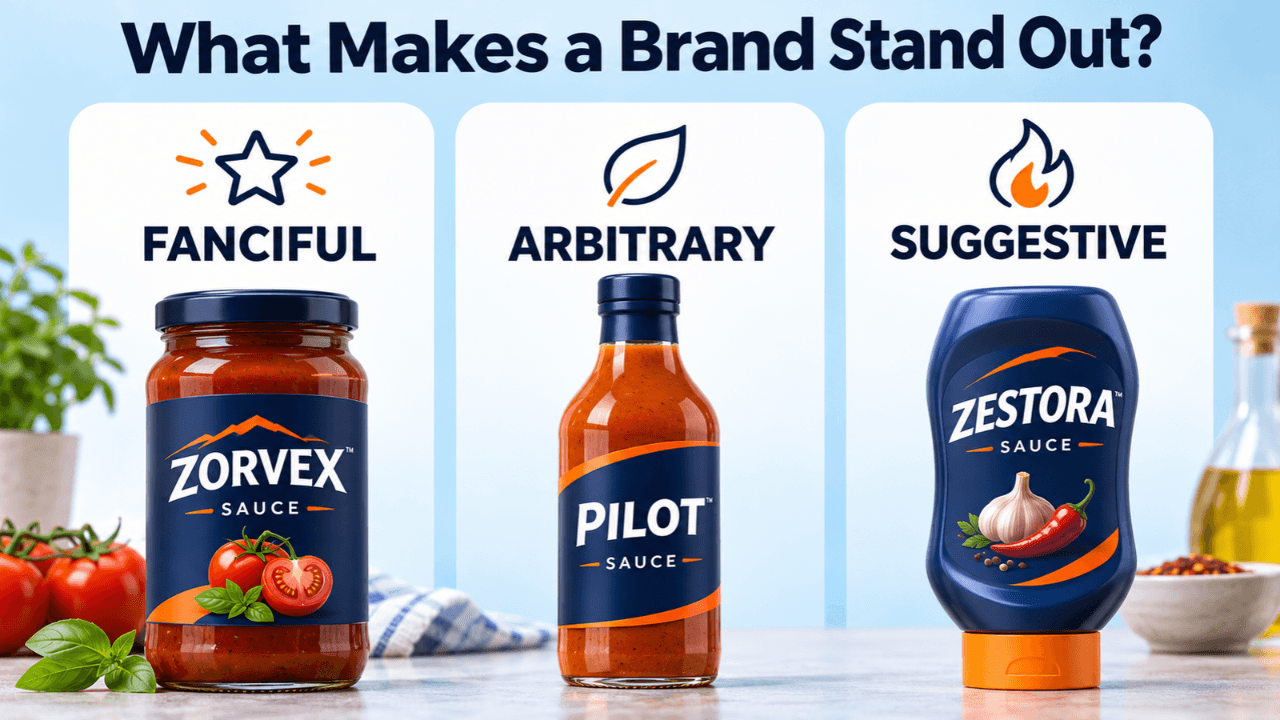
A food brand name must identify the commercial source of your products and meet applicable legal requirements.
The USPTO generally recognizes three categories of inherently distinctive trademarks:
- Fanciful marks: Invented words created for use as brands.
- Arbitrary marks: Familiar words used for unrelated products.
- Suggestive marks: Names that hint at a product's qualities without directly describing them.
Descriptive names may face registration difficulties unless they acquire distinctiveness. Generic product names cannot function as trademarks for those products.
For example, a distinctive invented name used on bottled sauce packaging may identify its manufacturer. In contrast, "Homemade Chili Sauce" generally describes the product rather than its commercial source.
Before investing in packaging, review Trademark Engine's guide on how to trademark a name.
Can You Trademark a Dish or Menu Item Name?
A dish name may qualify for trademark protection in certain circumstances, but appearing on a restaurant menu does not automatically establish trademark rights.
The USPTO Trademark Manual of Examining Procedure explains that a term used only to identify a menu item does not function as a trademark for restaurant services.
For example, "Smoky Sunset Burger" appearing only as a menu selection may simply identify a particular dish.
However, a distinctive name used to identify the source of separately marketed packaged foods may present a different situation.
The deciding factor is how consumers encounter and recognize the name, not merely whether it sounds creative.
Can You Copyright a Recipe?
Copyright generally does not protect basic ingredient lists or ordinary cooking instructions. It may protect original creative expression accompanying a recipe.
The U.S. Copyright Office's Circular 33 explains that ingredients and simple directions are not copyrightable.
For example, a basic cake recipe listing flour, sugar, eggs, and baking instructions generally cannot receive copyright protection for those elements alone.
Which Recipe Materials May Be Copyrighted?
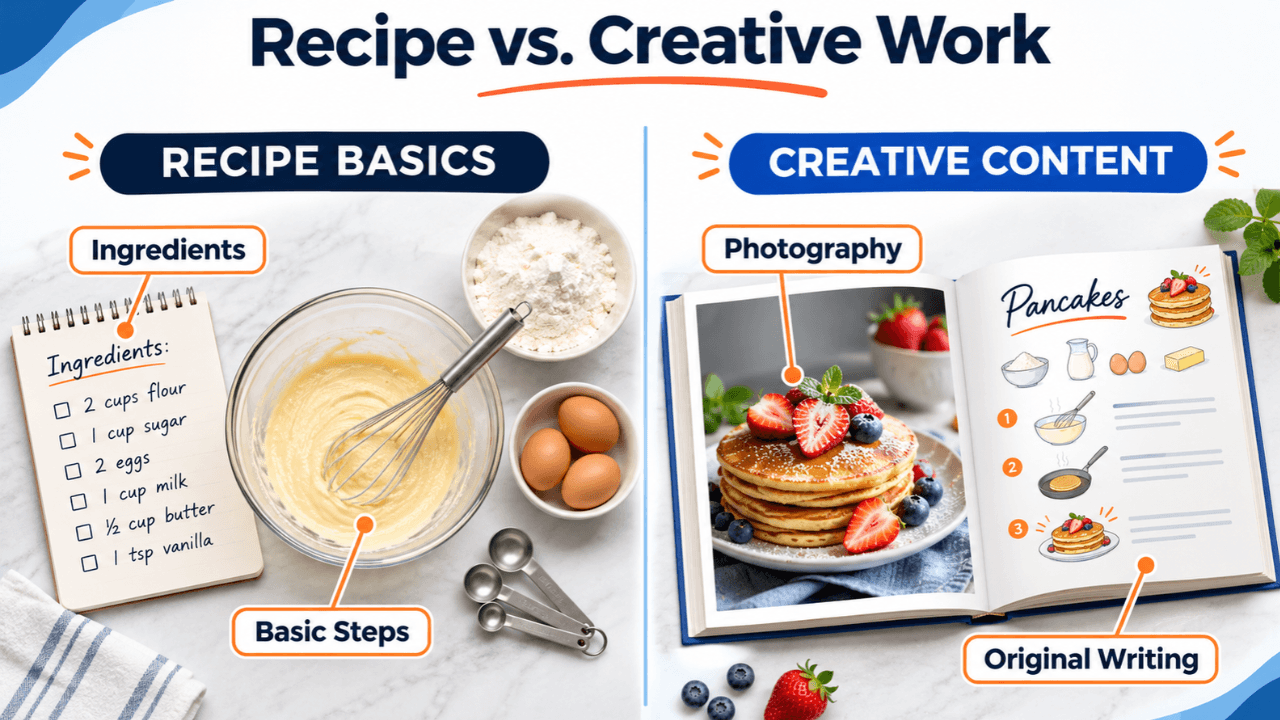
Copyright may protect qualifying original materials, including:
- Original stories or expressive descriptions accompanying recipes.
- Food photographs and illustrations.
- Creative explanations of cooking experiences.
- Original selection or arrangement of content in a cookbook.
Suppose two food bloggers publish chocolate cake recipes using similar ingredients.
They may prepare nearly identical cakes without that similarity alone establishing copyright infringement.
However, copying protected photographs or original written expression without permission may raise copyright concerns.
Important: The Copyright Office advises against including confidential recipes in copyright registration materials because applications and deposits may become publicly accessible.
Trademark vs. Copyright vs. Trade Secret for Recipes
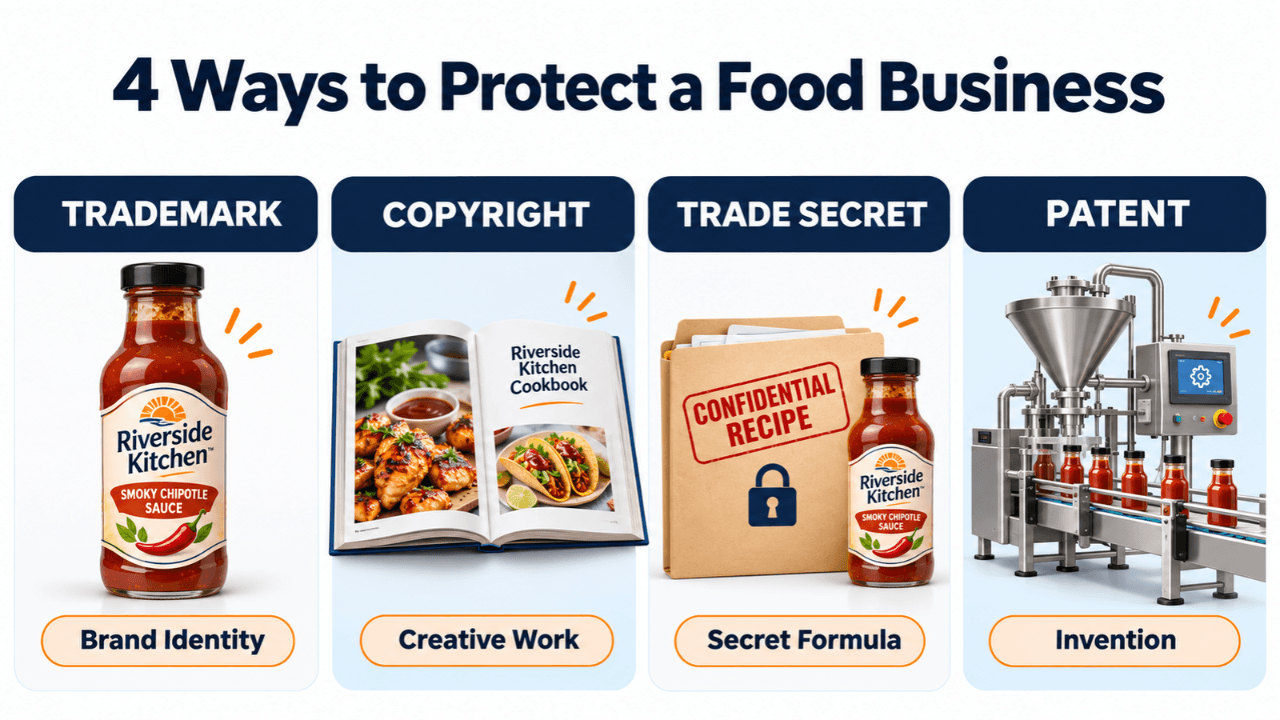
Different intellectual property laws protect different aspects of a food business. The appropriate choice depends on whether you want to protect a brand, creative expression, confidential information, or a qualifying invention.
| Protection | What It Protects | Food Business Example |
|---|---|---|
| Trademark | Distinctive source identifiers | Sauce brand name or logo |
| Copyright | Original creative expression | Cookbook writing and photographs |
| Trade secret | Valuable confidential information | Secret seasoning formula |
| Patent | Qualifying inventions | Innovative food-processing method |
A business can use several protections together without treating them as interchangeable.
When Might Patent Protection Be Relevant?
Certain food compositions or manufacturing processes may qualify for patent protection if they meet requirements such as novelty, usefulness, and nonobviousness.
However, changing a familiar recipe does not automatically create a patentable invention.
Patent applications also involve disclosure requirements, while trade-secret protection relies on preserving confidentiality.
Businesses developing genuinely new food technology should consider professional advice before disclosing an invention publicly.
For most food founders, the immediate question is whether they have developed a protectable brand name, confidential formula, or both.
How to Protect a Secret Sauce Recipe Legally
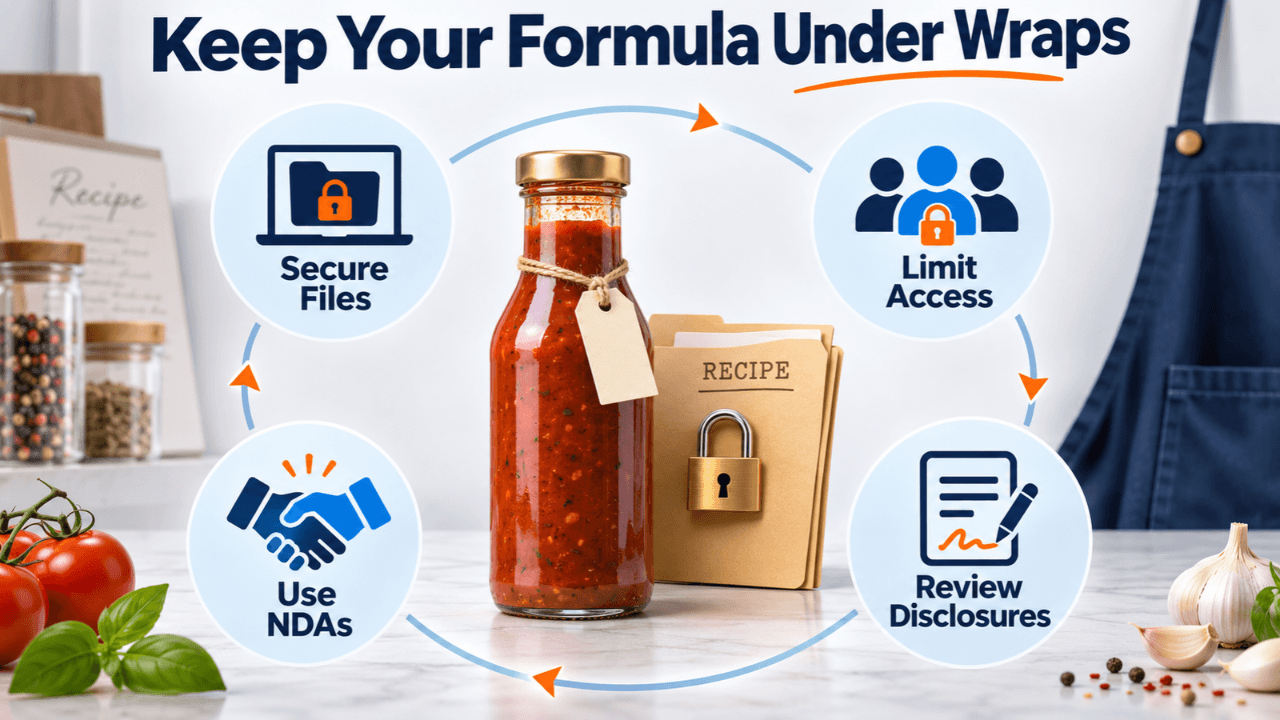
A valuable secret sauce recipe may qualify for trade-secret protection if it is not generally known, derives economic value from secrecy, and is subject to reasonable confidentiality measures.
Unlike federal trademark registration, trade-secret protection does not require a USPTO application.
Restrict Access to Confidential Information
Keep the complete formula secure and share it only with people who need access.
Practical measures include:
- Password-protected recipe files.
- Restricted access to exact ingredient ratios.
- Secure production and testing records.
- Separate access permissions for employees and suppliers.
These measures help demonstrate that your business actively treats the formula as confidential.
Use Appropriate Confidentiality Agreements
Nondisclosure agreements can help establish expectations when employees, manufacturers, or contractors receive sensitive information.
A useful agreement should define the confidential material and explain how recipients must handle it.
However, a signed agreement does not replace practical security measures. Businesses must continue protecting the information throughout their operations.
Understand the Limits of Secrecy
Trade-secret protection can become unavailable if a formula becomes generally known or the owner fails to take reasonable confidentiality measures.
It generally does not prevent others from independently developing a similar recipe or lawfully reverse engineering a product.
The USPTO's trade-secret guidance explains the importance of maintaining secrecy.
Food companies must also comply with applicable ingredient-labeling and allergen-disclosure requirements. Confidentiality cannot override these legal obligations.
How to Trademark a Food or Drink Brand in Five Steps
Federal trademark registration can provide benefits for eligible food brands. The process begins with choosing a distinctive mark and confirming that the application accurately reflects your business.
Step 1: Choose a Name That Identifies Your Business
Select a name that distinguishes your products rather than simply describing their ingredients or qualities.
Consider whether customers can recognize it on packaging, websites, and promotional materials.
A name that supports future product expansion may also be more practical than one tied to a single flavor or recipe.
Step 2: Conduct a USPTO Trademark Search
Search for potentially conflicting marks before investing in product packaging or advertising.
Your research should consider:
- Exact names and alternative spellings.
- Similar pronunciations and meanings.
- Marks used for related products or services.
- Relevant unregistered business names and commercial uses.
Example: Identifying a Potential Conflict
Suppose you plan to sell sauces under the fictional name Copper Spoon Sauces.
Your research identifies another hypothetical business called Copper Spoons Kitchen that sells related packaged foods.
Even though the names differ slightly, their similarities could raise a likelihood-of-confusion concern.
The assessment would depend on the marks' overall commercial impressions, relatedness of the products, and other relevant factors.
These names are hypothetical examples, not actual trademark search results.
The USPTO's trademark searching guidance explains the importance of researching potentially similar marks.
Trademark Engine's comprehensive trademark search can help identify possible conflicts before filing.
Step 3: Select the Appropriate Trademark Class
The USPTO uses 45 international classes to organize goods and services.
Common classifications for food businesses include:
| Class | Common Examples |
|---|---|
| 29 | Processed foods, dairy products, jams |
| 30 | Sauces, spices, bakery products |
| 32 | Beer and many nonalcoholic beverages |
| 33 | Many alcoholic beverages other than beer |
| 43 | Restaurant and catering services |
A restaurant that also sells packaged sauces may need to consider separate classes for its services and products.
Choose the classification that accurately describes what your business sells.
The USPTO's goods and services guidance and ID Manual can help you identify acceptable descriptions.
Step 4: Prepare Your Application and Supporting Evidence
Your application must identify the correct trademark owner, mark, goods or services, and filing basis.
Two common filing bases are:
- Use in commerce: You already use the mark in qualifying commercial activity.
- Intent to use: You have a genuine intention to use the mark commercially but have not yet begun qualifying use.
For packaged sauces, an actual product label displaying the trademark may qualify as evidence of use, called a specimen.
An ecommerce product page may also qualify when it connects the mark with goods available for purchase and satisfies USPTO requirements.
Webpage specimens must include the URL and the date the page was accessed or printed.
Review the USPTO specimen requirements before submitting evidence.
Step 5: File and Track Your Trademark Application
As of November 2026, the USPTO's base electronic filing fee for qualifying Section 1 and Section 44 applications is $350 per class.
| Application | Base Government Fee |
|---|---|
| One class | $350 |
| Two classes | $700 |
Additional government fees may apply for incomplete information, certain custom goods descriptions, or later intent-to-use filings.
The USPTO reviews applications and may issue an office action requesting clarification or raising a legal objection.
Registration is not automatic. Applicants must also meet applicable deadlines and post-registration requirements.
Check the USPTO's current fee information before submitting your application.
Common Food Brand Protection Mistakes to Avoid

Small mistakes during product development or trademark filing can create unnecessary legal and business complications.
Some important issues include:
- Choosing a highly descriptive name: A name that simply describes your product may be difficult to protect.
- Using the wrong trademark owner: Naming an individual when the company legally owns the mark, or vice versa, can create serious filing problems.
- Overlooking unregistered marks: A federal database search alone may not identify every relevant existing right.
- Submitting a packaging mockup: A digital concept generally cannot establish genuine commercial use when a specimen is required.
- Assuming registration covers every product: Trademark protection relates to the mark and the relevant goods or services, not every future product automatically.
Reviewing these issues before filing can help you prepare a more accurate application.
What Legal Requirements Apply Before Selling Food Products?
Trademark registration addresses brand identity, but food entrepreneurs must separately review licensing, product safety, labeling, and other business requirements.
Before selling packaged sauces, homemade snacks, or bakery products, consider the following:
| Requirement | What to Check |
|---|---|
| Business registration | Applicable state and local registration rules |
| Food permits | Manufacturing, retail, or food-service permissions |
| Product labeling | Ingredients, allergens, and nutrition disclosures |
| Production facilities | Whether an approved facility is required |
| Online sales | Applicable shipping and interstate commerce rules |
The FDA's food business guidance explains that requirements vary based on the product and the activities involved.
If you're preparing food at home, check your state's cottage-food laws and whether your product qualifies.
These startup legal requirements should be considered independently of trademark registration.
Conclusion
Protecting a food business starts with understanding what makes each asset valuable. Trademarks can safeguard distinctive brand identities, copyright may protect original creative content, and trade-secret measures can help preserve confidential formulas.
The right approach depends on your products, business activities, and future plans. By identifying your legal needs early, you can make informed decisions about naming, product development, and brand protection before investing in growth.
Ready to Protect Your Food Brand?
Explore Trademark Engine's trademark registration service to begin protecting an eligible food business name or logo. Registration depends on USPTO examination, and applicable government filing fees apply.
Trademark Engine Editorial Team
Frequently Asked Questions
Ownership depends on the relevant legal rights, employment agreements, and applicable law. Businesses should clarify ownership of confidential formulas, inventions, and copyrightable materials in written agreements rather than assuming every employee-created recipe automatically belongs to the employer.
Often, yes. Basic ingredients and cooking methods generally are not protected by copyright. However, reproducing protected photographs or original writing may require permission. Separate contractual, patent, or confidentiality obligations could also affect a particular situation.
There is no universal one-ingredient rule. Changing a recipe does not automatically resolve patent, trade-secret, or contractual issues. Whether a modification matters depends on the specific legal protection and circumstances involved.
No. Individuals and qualifying business entities may own federal trademarks. An LLC is not a general requirement for registration. However, the application must correctly identify the legal owner of the mark.
Generally, yes. Businesses may use ™ to indicate a claim of trademark rights before federal registration. However, the symbol alone does not establish enforceable rights. The ® symbol is reserved for federally registered marks and must be used appropriately.
Potentially, yes. Sharing a formula with a manufacturer does not necessarily eliminate trade-secret protection when appropriate confidentiality safeguards remain in place. Written agreements, limited access, and clear information-handling procedures can help preserve secrecy during production.
Get Trademark Tips and Compliance Guidance
Subscribe for updates, insights, and resources that help you stay compliant and grow your mission.