How Can Businesses Keep Track of Multiple Trademarks and Their Deadlines?

Published on October 28, 2026
Estimated Read Time: 11 minutes

Key Takeaways
- Each federal trademark registration has its own maintenance schedule.
- A central tracker keeps registration details, deadlines, and responsibilities organized.
- Most U.S. registrations require maintenance filings in years 5–6 and 9–10, followed by ten-year cycles.
- USPTO status checks help confirm filing requirements and registration information.
- Reviewing continued use, ownership, and filing costs helps businesses prepare for future renewals.
Quick Answer: Businesses can manage multiple trademarks by keeping a central registration tracker, recording individual USPTO deadlines, and setting automatic reminders. Regular status checks and organized ownership records help keep each trademark's maintenance requirements on schedule.
Managing one trademark may be straightforward. But as a business expands, it may register additional brand names, logos, slogans, or product lines.
Each registration can have a different filing date, renewal schedule, and set of requirements. For ecommerce founders managing several brands, these details can become difficult to track.
Missing a maintenance deadline may result in losing a federal registration. That makes an organized tracking process important, even for businesses with only a few registered marks.
Fortunately, you do not need expensive software to manage multiple trademarks. A spreadsheet, calendar reminders, and regular checks of USPTO records can provide a practical starting point.
Here is how to organize your portfolio, identify upcoming deadlines, and maintain accurate records as your business grows.
Why Do Businesses Need a Trademark Management System?
A trademark management system helps businesses keep track of their registrations, filing obligations, ownership records, and continued use.
For example, a company may register its business name first and later obtain separate registrations for a logo and product line. Although the same company owns these marks, each registration may require maintenance at a different time.
Without a central record, important information can remain scattered across emails, certificates, and filing documents.
A structured system makes it easier to identify upcoming obligations, assign filing responsibilities, and assess whether each trademark still supports the business.
It also creates a reliable record when employees change roles or ownership information needs updating.
How Can Businesses Manage Multiple Trademark Registrations?
Businesses can organize several registrations by maintaining one portfolio tracker, assigning clear responsibilities, and keeping supporting documents accessible.
Create a Central Trademark Portfolio Tracker
Start with a spreadsheet or digital database containing every pending application and active registration.
Include these fields:
| Information | Purpose |
|---|---|
| Trademark name | Identifies the registered brand |
| Serial and registration numbers | Locates the USPTO record |
| Registration date | Determines maintenance schedules |
| Trademark classes | Identifies covered goods or services |
| Current owner | Tracks legal ownership |
| Registration status | Shows the mark's current standing |
| Next filing window | Identifies upcoming requirements |
| Responsible person | Establishes accountability |
| Document folder | Stores certificates and filing records |
Add separate columns for the filing window's opening date, deadline, and grace-period end date.
This makes it easier to sort registrations by upcoming deadlines instead of reviewing each record individually.
Assign Filing Responsibilities and Reminders
Every trademark should have a designated person responsible for reviewing its maintenance requirements.
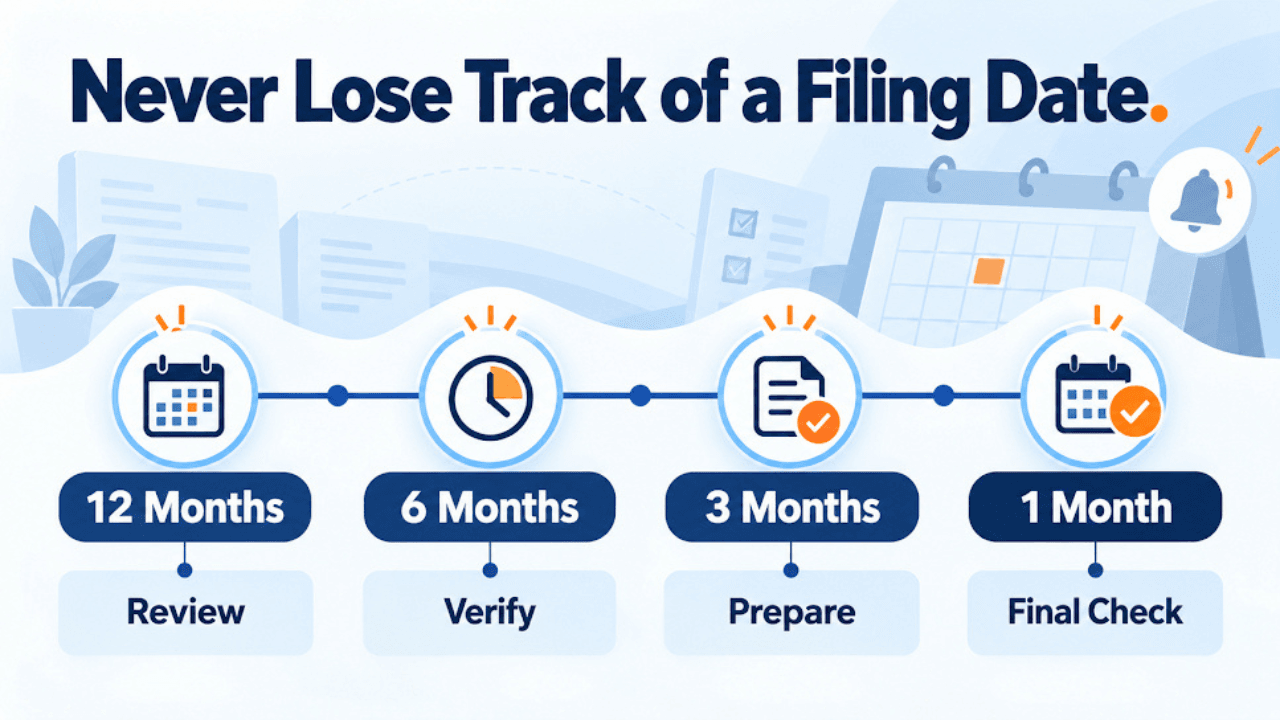
Set calendar reminders well before filing deadlines. A practical schedule includes reminders 12, 6, 3, and 1 month before the deadline.
These are internal planning suggestions, not USPTO requirements.
Use the early reminders to verify registration details and prepare documents. Later reminders can prompt a final review and timely submission.
Maintain a backup contact so deadlines are not overlooked when an employee leaves or changes roles.
Keep Trademark Documents Organized
Create a digital folder for each registration.
Store registration certificates, USPTO correspondence, previous filings, ownership documents, and evidence of continued trademark use.
For ecommerce businesses, useful evidence may include qualifying product labels, packaging photographs, or online sales pages showing the trademark.
However, not every screenshot or product photograph qualifies as a specimen. Review the USPTO's specimen requirements before submitting evidence.
What Trademark Deadlines Should Businesses Track?
Most U.S. federal registrations require a Section 8 filing between the fifth and sixth anniversaries of registration. Later maintenance and renewal filings follow a ten-year cycle.
The standard schedule for registrations outside the Madrid Protocol system is:
| Filing Period | Required Filing | Purpose |
|---|---|---|
| Years 5–6 | Section 8 Declaration | Confirms continued use or qualifying excusable nonuse |
| Years 9–10 | Combined Sections 8 and 9 | Maintains and renews registration |
| Years 19–20 | Combined Sections 8 and 9 | Completes the next renewal |
| Every 10 years afterward | Combined Sections 8 and 9 | Continues registration maintenance |
Additional government fees apply.
The USPTO's registration maintenance guidance explains these requirements.
Is Section 15 Required for Trademark Maintenance?
No. Section 15 is an optional Declaration of Incontestability available to qualifying registrations, generally after five years of continuous use.
It does not replace mandatory Section 8 or Section 9 filings.
Businesses with Madrid Protocol-based registrations must also consider Section 71 requirements and separate international renewal procedures.
For more information about maintaining federal registrations, see Trademark Engine's guide on how and when to renew your trademark.
Can Multiple Trademarks Have Different Renewal Dates?

Yes. Each registration follows its own schedule based on the date the USPTO registered the mark, even when one company owns them all.
Consider a fictional ecommerce business managing three brands:
| Trademark | Registration Date | First Maintenance Window |
|---|---|---|
| BloomNest | March 2021 | March 2026–March 2027 |
| BloomGlow | July 2023 | July 2028–July 2029 |
| BloomCare | January 2025 | January 2030–January 2031 |
These examples illustrate the standard Section 8 filing window. Actual deadlines depend on each registration's exact anniversary date.
Filing maintenance documents for BloomNest does not automatically satisfy the requirements for the other two registrations.
How Do Businesses Manage Trademarks Across Multiple Classes?
Some registrations protect goods or services in more than one trademark class.
For example, a skincare business might register a mark for cosmetics in Class 3 and certain retail services in Class 35.
Before filing maintenance documents, the business should confirm that the mark remains in use for the listed goods or services and gather appropriate specimens for each applicable class.
If certain products or services are no longer offered under the mark, the registration may need to be updated by deleting those items.
The USPTO's post-registration FAQs explain these requirements.
How Much Does It Cost to Maintain Multiple Trademarks in 2026?
Federal trademark maintenance costs depend on the required filing and the number of registered classes.
The USPTO's electronic filing fees are:
| Filing Type | Government Fee |
|---|---|
| Section 8 Declaration | $325 per class |
| Optional Section 15 Declaration | $250 per class |
| Combined Sections 8 and 9 | $650 per class |
| Section 8 during grace period | $425 per class |
| Combined Sections 8 and 9 during grace period | $850 per class |
For example, a business renewing three separate one-class registrations through timely combined Sections 8 and 9 filings would pay $1,950 in USPTO fees.
The same government fee applies to one registration covering three classes when all three classes are maintained through that combined filing.
These amounts do not include optional professional assistance or other applicable fees.
For the latest amounts, consult the USPTO fee schedule.
Budgeting tip: Add estimated maintenance expenses and payment years to your portfolio tracker. This helps you plan when several registrations have deadlines close together.
How Can Businesses Verify Trademark Status and Ownership?
Businesses can check their registration information directly through official USPTO records.
Check Trademark Status Using TSDR
The USPTO's Trademark Status and Document Retrieval system, known as TSDR, provides public application and registration records.
Follow these steps:
- Enter the trademark's serial or registration number.
- Review its current status.
- Open the Documents section to check filing history and correspondence.
- Review the Maintenance section for required filings.
- Update your internal tracking record.
Check the record after submitting maintenance documents to confirm their status and identify any USPTO notices requiring action.
Record Changes to Trademark Ownership
Ownership information may change when a company sells a brand, transfers assets, merges with another business, or changes its legal name.
Maintain the relevant supporting documents and review the USPTO's trademark assignment procedures.
After recording a change, verify that official records reflect the correct owner.
Ownership and correspondence information serve different purposes, so review both when business details change.
How Can Businesses Avoid Missing Trademark Deadlines?
The most reliable approach is to review the portfolio regularly and confirm that someone is responsible for each upcoming filing.
Use this checklist during quarterly reviews:
- Confirm the status of active registrations.
- Check filing deadlines for the next 12 months.
- Review USPTO correspondence and outstanding notices.
- Verify ownership and contact information.
- Confirm continued use for covered goods and services.
- Check required documents and assigned responsibilities.
- Save filing receipts and verify their status.
What Happens If a Business Misses a Maintenance Deadline?
If the normal filing window closes, the trademark owner can generally submit the required documents during the following six-month grace period by paying additional fees.
Missing the grace period can lead to cancellation or expiration of the federal registration.
A business seeking federal registration again may need to submit a new application and complete the examination process.
Although some common-law trademark rights may continue through actual use, these are different from the benefits of federal registration.
Learn more about missing a trademark renewal deadline.
How Can Businesses Manage a Growing Trademark Portfolio?
A growing trademark portfolio needs a process that can accommodate new registrations, changing business needs, and additional filing responsibilities.
As the number of marks increases, dedicated management software may help organize records, generate reminders, and support team collaboration.
However, businesses should also distinguish between trademark maintenance and trademark monitoring.
Trademark maintenance involves completing required filings to keep registrations active.
Trademark monitoring involves reviewing potentially conflicting trademark applications or unauthorized use that could affect existing brands.
Companies introducing new product names should consider conducting a trademark search before filing additional applications.
Periodic portfolio reviews also help identify brands that are no longer used, registrations that may need updating, and new protection needs.
Conclusion
Businesses can manage multiple trademarks more effectively by keeping accurate registration records, tracking individual filing dates, and reviewing USPTO information regularly.
A central portfolio tracker, advance reminders, and organized supporting documents make maintenance requirements easier to handle.
As your business adds new brands, review trademark use, ownership, and upcoming fees to keep your records current. A consistent process helps reduce missed deadlines and supports long-term brand management.
Keep Your Trademark Portfolio Organized With Trademark Engine
Managing existing registrations is important, but adding a new brand also requires careful planning.
Before applying for another trademark, explore Trademark Engine's comprehensive trademark search to identify potentially conflicting marks.
When you are ready to pursue federal protection, Trademark Engine's trademark registration services can help you understand and complete the application process. Applicable USPTO filing fees are additional, and registration decisions rest with the USPTO.
Trademark Engine Editorial Team
Get Trademark Tips and Compliance Guidance
Subscribe for updates, insights, and resources that help you stay compliant and grow your mission.