Common Trademark Mistakes AI Startups Make and How to Avoid Them

Published on October 5, 2026 | Updated on October 16, 2026
Estimated Read Time: 10 minutes
Key Takeaways
- An available domain or LLC name does not confirm trademark availability.
- AI-generated names and logos still require trademark clearance.
- Similar marks can conflict even when they are spelled differently.
- Trademarks protect brand identifiers, not the underlying AI technology itself.
- Your application should accurately reflect your owner, filing basis, and actual goods or services.
- Figma prototypes and draft websites are not automatically valid trademark specimens.
Quick Answer: Common trademark mistakes for AI startups include choosing a weak brand, relying on an exact-name search, incorrectly describing software or services, filing under the wrong owner or basis, and using mockups as proof of use. Planning for trademark protection before launch can prevent many avoidable filing and branding problems.
AI founders are entering a busier U.S. trademark environment. During the first half of FY2026, the U.S. Patent and Trademark Office received 431,734 trademark application classes, up 7% from 403,353 during the same period in FY2025.
For startups moving quickly from naming to prototype to launch, trademark decisions should develop alongside the product. A distinctive name, meaningful clearance search, accurate application, and proper evidence of use can support stronger brand name protection and reduce preventable issues during the trademark registration process.
Choosing an AI Brand Name That Is Too Descriptive
A name that mainly describes what an AI product does can be harder to distinguish and protect as a brand.
AI companies often use terms such as “AI,” “assistant,” “generator,” “automation,” “smart,” or “analytics.” Those terms are not automatically unavailable, but their relationship to the complete mark and the relevant goods or services matters.
The USPTO explains that stronger trademarks tend to be distinctive, while generic or highly descriptive wording is generally more difficult to protect.
For example, instead of relying on a name that simply means “AI inventory forecasting,” you could use:
Distinctive Brand Name
AI-powered inventory forecasting platform
The product description tells customers what the platform does. The distinctive name tells them who provides it.
For a deeper look at name strength, naming patterns, and clearance before launch, see Trademark Engine's guide to choosing a trademarkable name for an AI tool.
Assuming an AI-Generated Name or Available Domain Is Clear
An AI-generated name, available domain, or open social handle does not establish trademark availability.
AI naming tools can generate dozens of brand ideas within seconds. But generating a name does not amount to conducting a trademark search.
Two marks need not be identical to create a likelihood-of-confusion issue. The USPTO considers similarities between marks, as well as whether the goods or services are related.
Domain, LLC, and Trademark Availability Are Different
| Check | What It Actually Tells You |
|---|---|
| Domain Search | Whether a specific web address is available |
| State Business Search | Whether an entity name can generally be registered in that state |
| Social Search | Whether a username is available on a platform |
| Trademark Clearance | Whether earlier trademark rights may create a conflict |
For brand name protection, these checks should complement one another rather than replace trademark clearance.
Search Similar Marks, Not Just Exact Matches
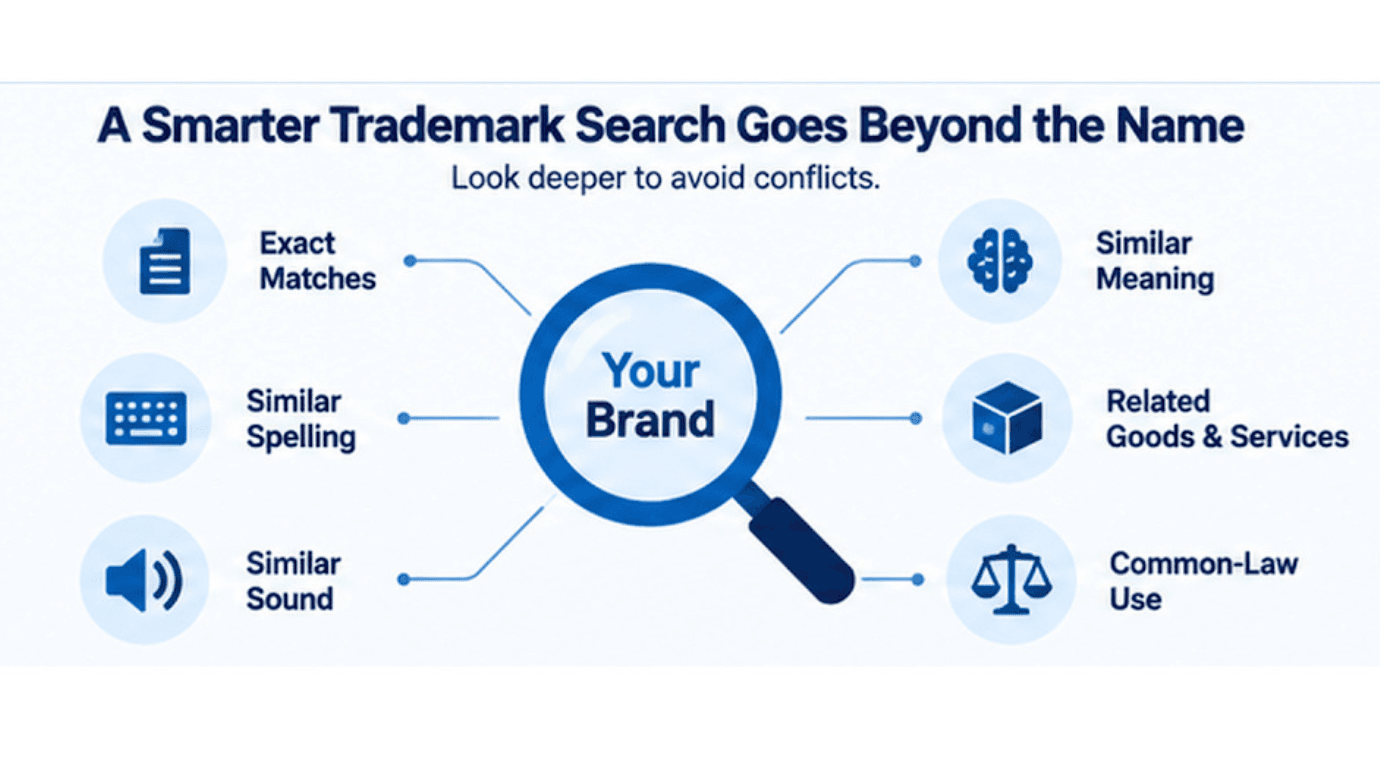
One of the trademark mistakes startups make is searching only the exact proposed name.
A broader search can consider:
- pending and registered federal marks
- alternative spellings
- phonetic variations
- similar meanings
- related goods and services
- state trademark records
- internet and common-law uses
The USPTO recommends a comprehensive clearance search that may include its federal database, state trademark databases, and internet research.
For example, an AI customer-support platform could encounter a relevant mark that uses different spelling but sounds similar and serves a related market.
Founders who want a broader review before committing heavily to a brand can explore Trademark Engine's comprehensive trademark search.
What Does Trademark Infringement Mean?
In practical terms, trademark infringement involves unauthorized use of a mark that may cause consumers to be confused about the source, sponsorship, or connection of goods or services.
The key issue is therefore not simply whether two names are identical. Both the similarity between the marks and the relationship between the goods or services can matter.
This is why examples of trademark infringement should be evaluated based on their specific facts rather than on spelling alone.
Confusing the AI Brand With the Technology
A trademark generally protects the brand customers use to identify your company or product—not the underlying AI algorithm itself.
Startup intellectual property can involve several forms of protection.
| Startup Asset | IP Area That May Be Relevant |
|---|---|
| Company or Product Name | Trademark |
| Logo Used as a Brand Identifier | Trademark; copyright may also be relevant |
| Software Code | Copyright may be relevant |
| Technical Invention or Process | Patent protection may be relevant |
| Confidential Methods or Information | Trade-secret protection may be relevant |
The USPTO describes a trademark as a word, phrase, symbol, design, or combination that identifies the source of goods or services.
So instead of asking only, “Can I trademark my AI algorithm?” consider which company name, product name, app name, logo, or slogan customers use to recognize the source.
AI-generated logos can create an additional copyright question. In 2025, the U.S. Copyright Office concluded that generative-AI output can qualify for copyright protection when sufficient human-authored expression is present, while merely providing prompts does not by itself establish authorship.
Trademark and copyright questions should therefore be considered separately.
Describing AI Software, SaaS, or Services Incorrectly
Calling an offering simply “AI software” may not describe clearly enough what customers actually receive.
AI startup trademark registration mistakes can arise because a technology company may provide downloadable software, hosted SaaS, APIs, consulting, data processing, or several offerings at once.
| AI Offering | Question to Clarify |
|---|---|
| Downloadable Application | What software does the customer download? |
| Browser-Based Platform | What hosted or SaaS functionality is provided? |
| API | What functionality or service does it provide? |
| AI Consulting | What service is performed for customers? |
| Ecommerce AI Tool | Is the offering software, a service, or both? |
| Future Product | Is there a genuine intention to offer it? |
The USPTO requires goods and services descriptions to be clear and accurate. Applications must also use the appropriate filing basis for the goods and services claimed.
If you want more background on how the USPTO organizes goods and services, Trademark Engine's trademark class guide explains the classification system in plain language.
Avoid Filing for Every Roadmap Idea
An AI startup might launch one tool today and plan to build an API, an enterprise dashboard, or an industry-specific product later.
That does not mean every possible idea automatically belongs in the application.
Your listed goods and services should reflect what you actually provide or genuinely intend to provide under the applicable filing basis.
Filing Under the Wrong Owner or Filing Basis
The application should identify the actual trademark owner and use a filing basis that reflects the startup's real commercial stage.
A common startup sequence looks like this:
Founder chooses name → company forms → prototype launches → customers arrive → trademark application is filed
The founder and company should not automatically be treated as interchangeable.
USPTO base application requirements include the applicant's name, legal entity, filing basis, filing fee, verified statement, and properly classified goods and services.
Use in Commerce vs. Intent to Use
Two filing bases are especially relevant to U.S. startups.
Section 1(a) — Use in Commerce:
The trademark is already being used in qualifying commerce with the claimed goods or services.
Section 1(b) — Intent to Use:
The applicant has a bona fide intention to use the mark but has not yet established qualifying use.
The USPTO permits intent-to-use applications when the applicant has a genuine plan to use the mark in commerce, but actual use generally must be established before registration.
This distinction matters for AI startups moving through:
concept → prototype → private beta → public launch → paid product
A working prototype alone does not necessarily establish qualifying trademark use.
Using a Prototype as a Trademark Specimen
A Figma screen, concept website, or polished product mockup is not automatically acceptable evidence of trademark use.
Technology startups often create materials that look finished long before the product reaches the marketplace.
Examples include:
- Figma prototypes
- private product demos
- investor presentations
- draft landing pages
- app mockups
- rendered packaging
A trademark specimen serves a different purpose.
USPTO guidance requires a specimen to show a real example of how the trademark is used in commerce with the claimed goods or services. Mockups, digitally altered images, intended packaging renders, and draft websites showing only how a mark might appear may not satisfy that requirement.
For webpage specimens, the submission generally must also include the page URL and the date the webpage was accessed or printed.
For AI and SaaS businesses, it is therefore useful to distinguish product-design evidence from trademark-use evidence.
Treating Registration as the Finish Line
Trademark protection continues after registration because registrations must be maintained and the business may expand.
An AI startup might move from one SaaS product into an API, mobile application, enterprise platform, consulting service, or another offering.
As the business evolves, review whether your existing trademark protection still reflects what customers actually receive.
Federal registrations also require maintenance filings. For many registrations, required filings occur between years five and six, again between years nine and ten, and at later ten-year intervals.
Trademark owners are also responsible for deciding how to respond to potential infringement; registration does not mean the USPTO monitors the marketplace on the owner's behalf.
Trademark Engine's trademark monitoring service can help identify potentially similar new filings, although monitoring itself does not determine whether infringement has occurred.
Before Filing: Five Questions to Ask
Use these questions as a final check:
- Does the name identify my brand, or mainly describe the AI feature?
- Have I searched similar marks rather than only the exact wording?
- Am I protecting a brand identifier rather than confusing it with the underlying technology?
- Do my owner, goods or services, and filing basis match the actual business?
- If proof of use is required, does my specimen show genuine marketplace use?
If any answer is unclear, address it before relying heavily on the proposed brand.
Conclusion
Avoiding common trademark mistakes for AI startups starts with making trademark decisions earlier. Choose a distinctive brand, search beyond exact matches, describe your product accurately, confirm the owner and filing basis, and use genuine marketplace evidence when required. These steps cannot guarantee registration, but they can help you approach trademark protection with clearer information and fewer preventable filing issues.
If you have completed your brand research and are ready to file, Trademark Engine's trademark registration service can help you prepare and submit your application to the USPTO.
Trademark Engine Editorial Team
Frequently Asked Questions
Potentially, yes. A business name can function as a trademark when customers use it to identify the source of goods or services. Its distinctiveness and existing similar marks can affect registrability.
Trademark law generally protects source-identifying brands rather than the algorithm itself. Depending on what you are trying to protect, patent, copyright, or trade-secret law may raise separate questions.
An AI-generated logo may potentially function as a trademark if customers recognize it as identifying the source of goods or services. AI generation does not establish that the logo is clear of earlier trademark rights, and copyright questions should be considered separately.
No. An individual can own and apply for a trademark. The important issue is identifying the actual owner correctly when the application is filed.
Yes. A Section 1(b) intent-to-use application may be available when you have a bona fide intention to use the mark in commerce but have not yet established qualifying use. Actual use generally must be shown before registration.
The current USPTO base application fee is $350 per class. Additional fees may apply depending on the filing and how the goods and services are identified.
Get Trademark Tips and Compliance Guidance
Subscribe for updates, insights, and resources that help you stay compliant and grow your mission.