Can I Use a Shipping Label as a Trademark Specimen?

Published on November 23, 2026
Estimated Read Time: 12 minutes

Key Takeaways
- Shipping labels must demonstrate genuine trademark use to qualify as specimens.
- A return address alone generally identifies the sender, not the product brand.
- Product labels, hangtags, and branded packaging are common alternatives.
- Mockups and altered images cannot establish actual use of a trademark in commerce.
- Substitute specimens must meet specific use-date requirements.
- Selecting appropriate evidence before filing may help prevent avoidable refusals.
Quick Answer: Yes, a shipping label may qualify as a trademark specimen if it is attached to the goods or their containers and demonstrates proper trademark use. However, the USPTO generally will not accept a label that displays only your business name as a return address because it does not identify the source of the goods.
According to the USPTO's April 2026 report, the agency received 431,734 trademark application classes during the first half of fiscal year 2026, a 7% increase over the same period in 2025.
For ecommerce founders, trademark registration involves more than choosing a distinctive brand name. You must also provide suitable evidence of trademark use when required.
If your business name appears on shipping labels, you may wonder whether those labels qualify as proof.
This guide explains the USPTO's requirements, acceptable shipping label examples, common reasons for rejection, and practical steps for preparing evidence.
When Does a Shipping Label Qualify as a Trademark Specimen?
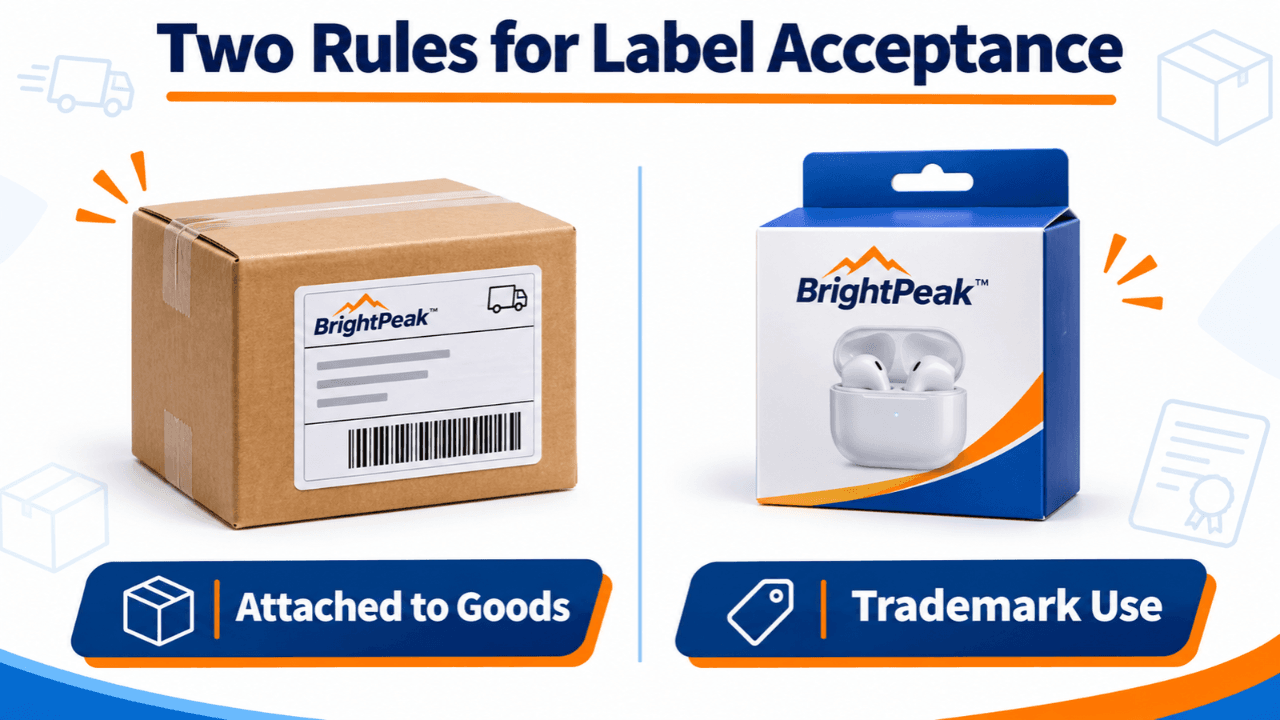
A shipping label may qualify when it is attached to the goods or their containers and shows the trademark functioning as an identifier of the products' source.
According to the USPTO's Trademark Manual of Examining Procedure (TMEP), Section 904.03(a), shipping and mailing labels may be acceptable when:
- The label is affixed to the goods or their containers.
- The mark demonstrates proper trademark use.
Both conditions matter. A company name printed on a package does not automatically satisfy the requirements.
How Does the USPTO Recognize Proper Trademark Use?
A trademark helps customers identify and distinguish products offered by one business from those offered by another.
For example, a candle brand displayed prominently on the product's actual packaging may function as a trademark because customers can associate it with those candles.
The USPTO considers the mark's placement, appearance, and relationship to the goods.
A shipping label should demonstrate this source-identifying function rather than merely displaying administrative information.
Can a Temporary Label Be Accepted?
Yes. The USPTO does not automatically reject a specimen simply because its label looks temporary.
Businesses may use temporary labels during normal commercial operations. However, the label must reflect genuine use in commerce.
If its appearance raises questions, an examining attorney may request additional information about how the label was used.
A temporary label prepared only for a trademark application, without actual qualifying commercial use, is insufficient.
Why a Return Address May Not Establish Trademark Use
A business name appearing only in a return address generally does not qualify as a trademark specimen for goods.
The USPTO distinguishes between a trade name, which identifies a business, and a trademark, which identifies the source of particular products.
The same name may serve both functions, depending on how it is used.
Example: Three Photographs From an Ecommerce Business
Imagine Blue Peak LLC, a fictional company selling scented candles under the BLUE PEAK brand.
The owner has three photographs available when preparing a trademark application.
Photograph A: Standard Shipping Label
The label displays “Blue Peak LLC” beside the return address, recipient details, and tracking barcode.
Assessment: Generally unacceptable because the company name appears only as sender information.
Photograph B: Branded Candle Jar
A genuine photograph shows BLUE PEAK printed prominently on the product label attached to a candle jar sold to customers.
Assessment: Generally acceptable because the mark identifies the source of the candles.
Photograph C: Branded Shipping Box
A genuine photograph shows BLUE PEAK displayed as the product brand on a box used to package the candles.
Assessment: Potentially acceptable if the box serves as a container for the goods and the mark functions as a trademark.
The distinction is important: the USPTO examines how customers encounter the brand, not simply whether the name appears somewhere on a package.
This example demonstrates why a trade name vs. trademark specimen refusal can occur even when a business is already selling products.
Shipping Labels, Product Labels, and Packaging Compared
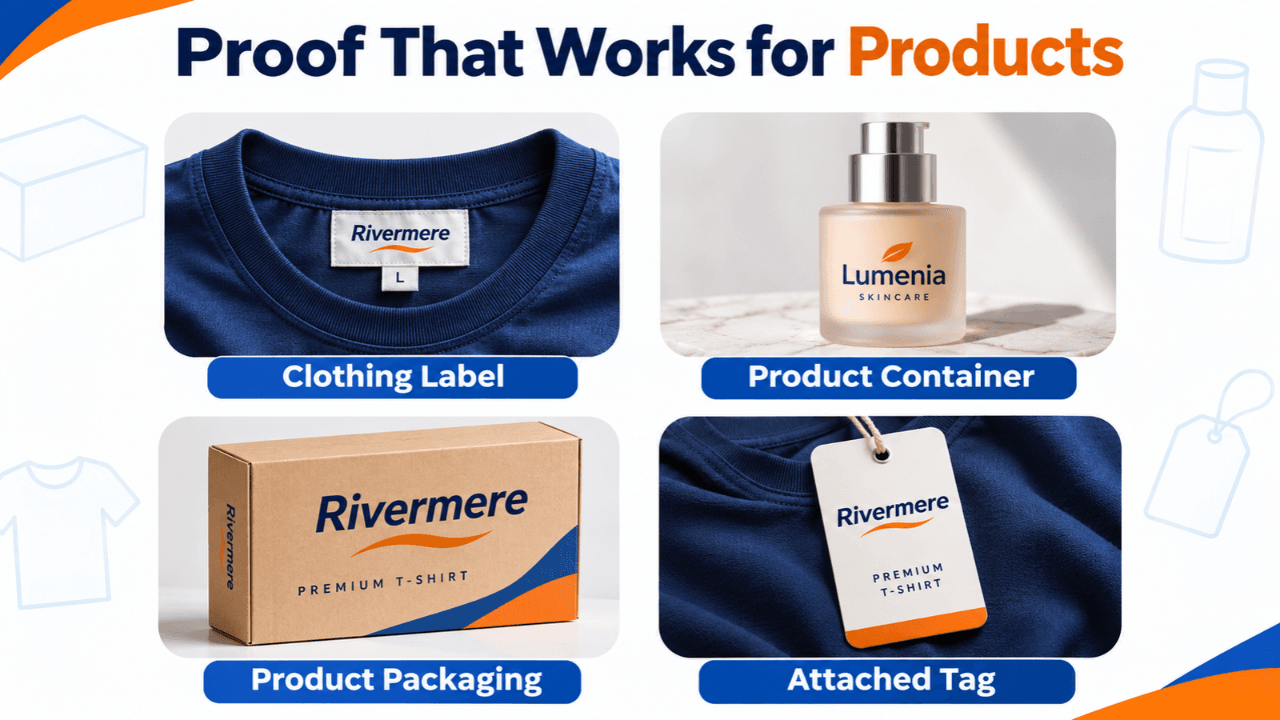
Product labels, attached tags, and branded containers are common types of trademark evidence because they can directly connect a mark with the goods.
Shipping documents require closer examination because their primary purpose may be delivery rather than branding.
The following table compares common trademark specimen examples for physical products.
| Specimen Example | Likely USPTO Treatment | Reason |
|---|---|---|
| Company name shown only in a return address | Generally unacceptable | Identifies the sender |
| Shipping label attached to goods and showing proper trademark use | Potentially acceptable | May identify the product's source |
| Genuine branded product label | Generally acceptable | Connects the mark with the goods |
| Hangtag attached to clothing | Generally acceptable | Displays the brand on merchandise |
| Branded retail packaging | Generally acceptable | Shows the mark on the product container |
| Shipping carton showing only courier details | Generally unacceptable | Provides delivery information |
| Digitally created packaging mockup | Unacceptable | Does not establish actual commercial use |
These are general assessments. Acceptance depends on the specific evidence and applicable legal requirements.
Can an Outer Shipping Box Serve as a Specimen?
Yes. A box used a contain goods may qualify if it displays the trademark in a source-identifying manner.
For example, a cosmetics company may send products in branded boxes bearing its product mark.
A genuine photograph of that packaging could demonstrate trademark use if the mark identifies the source of the goods.
However, displaying a business name beside a shipping barcode or return address does not automatically establish qualifying use.
Suitable Evidence for Different Products
The most useful evidence depends on the products and how customers receive them.
Clothing sellers may use sewn-in labels or branded hangtags. Candle manufacturers often display trademarks on jars, while cosmetics companies may use branded bottles or retail boxes.
For packaged food, photographs of actual product packaging may provide suitable evidence.
The USPTO's specimen guidance provides examples of acceptable trademark specimens for goods.
What Are the USPTO Requirements for Valid Specimens?
A specimen must show the applied-for trademark as actually used in commerce with the identified goods. The evidence must represent genuine commercial activity and satisfy the relevant filing requirements.
Before submitting a specimen, consider whether the trademark is visible, clearly associated with the goods, and supported by qualifying use.
1. Provide Genuine Commercial Evidence
The USPTO expects evidence reflecting how the mark appears in the marketplace.
A photograph of an actual branded product may qualify. A digital rendering showing how future packaging might look does not establish present use.
The USPTO's drawings and specimens guidance distinguishes between these two application elements.
A drawing identifies the trademark you seek to register. A specimen demonstrates how the trademark is used.
2. Match the Applied-For Trademark
The specimen must show a mark that sufficiently corresponds to the one in the application.
For a standard-character mark, the USPTO generally focuses on the wording rather than a specific font or color.
For a special-form mark, the design shown in the specimen must sufficiently match the applied-for design.
Material differences may create examination problems.
3. Demonstrate Use With the Identified Goods
The evidence must establish qualifying trademark use with the goods listed in your application.
For example, if you apply for a trademark covering scented candles, a photograph showing the mark only on unrelated clothing may not support that claim.
If your application includes several products, you must have qualifying use for all goods claimed. The USPTO may request additional evidence when necessary.
4. Satisfy the Applicable Use Dates
The timing depends on the filing basis.
- Section 1(a) — Use in Commerce: You generally must establish qualifying trademark use by the application filing date.
- Section 1(b) — Intent to Use: You may apply before qualifying use begins, but you must later submit the required allegation of use and specimen before registration.
The USPTO's filing-basis guidance explains these requirements.
5. Follow Webpage Specimen Rules
A product webpage may qualify when it directly associates the mark with the goods and provides a way for customers to order them.
For example, a genuine product listing containing the trademark, product details, and an ordering option may qualify.
A webpage specimen generally must include its URL and the date it was accessed or printed.
An ordinary homepage displaying only a business name may not satisfy the requirements.
For additional information, review Trademark Engine's trademark specimen guidelines.
Common Reasons the USPTO Rejects Specimens
The USPTO may refuse a specimen when it does not adequately demonstrate trademark use, lacks a clear connection to the goods, or fails to satisfy the applicable evidence requirements.
For ecommerce businesses, several problems deserve attention.
Submitting Ordinary Business Documents
Invoices, packing slips, and shipping receipts generally document business transactions rather than demonstrate trademark use for physical goods.
Although these documents may confirm a sale, they do not necessarily establish how customers encounter the trademark on the products.
Limited exceptions may apply when placing the mark on goods, packaging, or qualifying displays is impracticable.
Providing Unclear or Misleading Images
A blurred photograph, a cropped mark, or an image that obscures the relationship between the trademark and the product may create problems.
Submit authentic, readable evidence that accurately reflects commercial use.
Avoid altering photographs in ways that misrepresent how the mark appeared.
Relying on Business Registration Alone
Forming an LLC or registering a business name does not automatically establish trademark use for every product the company sells.
A company may operate under one legal name while marketing products under a separate trademark.
For specimen purposes, the evidence must show the applied-for mark functioning as an identifier of the relevant goods.
How to Respond to an Unacceptable Specimen Refusal
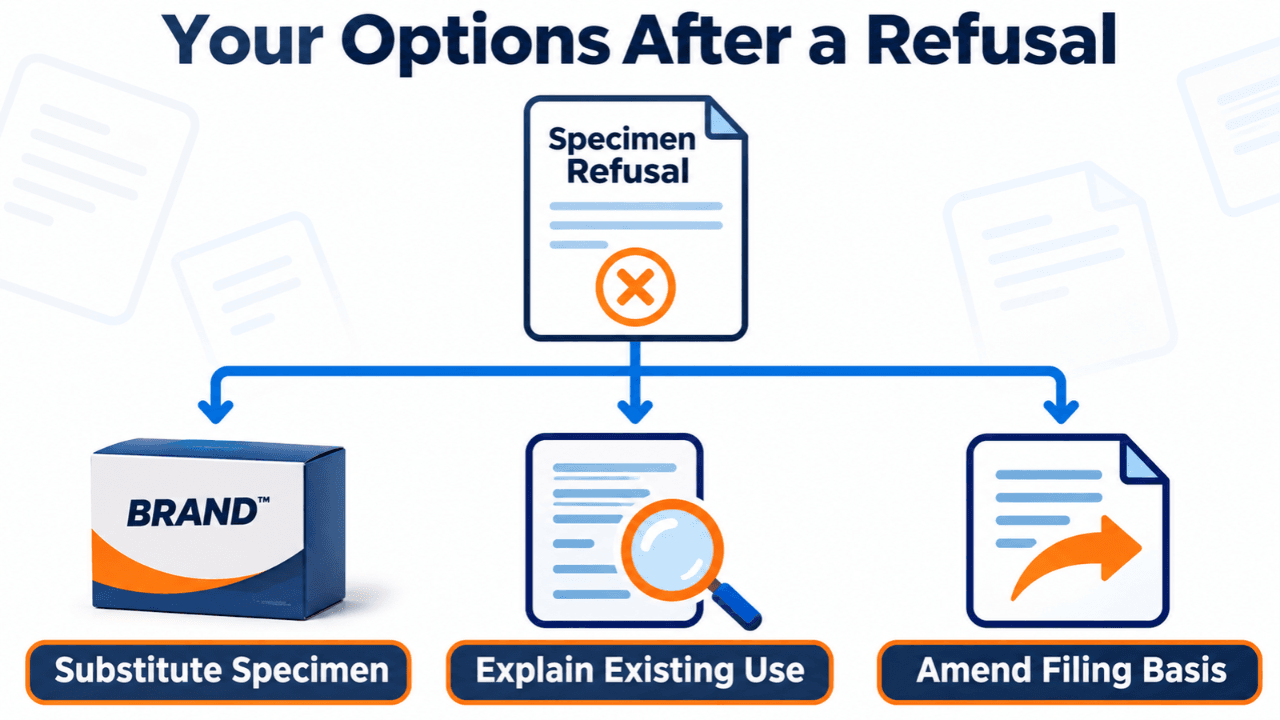
If the USPTO refuses your specimen, you may be able to provide a verified substitute, explain why the existing evidence qualifies, or pursue an available filing-basis amendment.
The appropriate response depends on the refusal and your application's circumstances.
Submit a Verified Substitute Specimen
A substitute specimen must show acceptable trademark use and satisfy the relevant timing rules.
For a Section 1(a) application, the substitute must have been used in commerce at least as early as the original filing date.
For an amendment to allege use, the substitute generally must have been used before the amendment was filed.
For a statement of use, it must have been used before the applicable statement-of-use deadline expired.
Applicants must also provide the required verified statement.
For example, a business that already used branded product packaging by the relevant date may be able to submit an authentic photograph of that packaging.
Creating new packaging after receiving a refusal cannot establish use before the required date.
Consider an Eligible Filing-Basis Amendment
In some circumstances, an applicant who originally filed under Section 1(a) may amend to Section 1(b), intent to use, if the legal requirements are satisfied.
This may allow the applicant to establish qualifying commercial use later in the process.
Additional filing steps and government fees may apply.
Address the Examiner's Specific Concerns
An office action may identify problems involving the mark's appearance, its relationship to the goods, or the authenticity and timing of the evidence.
Review the issues carefully and respond with relevant information.
The USPTO's office action instructions explain the general response process.
Trademark Engine also provides office action response assistance for applicants seeking support with examination issues.
How to Prepare Trademark Evidence Before Filing
Ecommerce sellers should select authentic evidence that clearly connects the trademark with their products.
A useful starting point is to review your specimen from a customer's perspective. Would the name appear to identify the product's brand, or would it look like ordinary business or delivery information?
That question can help you select clearer evidence, although it does not replace the USPTO's legal requirements.
Pre-Filing Checklist
- Identify the mark. Confirm the wording or design you want to register.
- Review the goods. Check that the specimen supports the products identified in your application.
- Choose suitable evidence. Use actual labels, attached tags, packaging, or qualifying sales displays.
- Check image quality. Ensure the trademark and its relationship to the goods are clear.
- Confirm qualifying use. Verify the relevant commercial-use and filing dates.
- Keep supporting records. Retain genuine photographs and relevant business documentation.
- Review your application. Compare the specimen with your trademark drawing, goods description, and filing basis.
Check Trademark Availability Separately
An acceptable specimen does not mean your proposed mark is available for registration.
The USPTO may identify conflicting trademarks even when your evidence meets the specimen requirements.
A trademark search can help you identify potentially conflicting marks before investing further in registration.
For startup founders, reviewing trademark availability is an important part of brand protection and broader business legal planning.
Conclusion
A shipping label may qualify as a trademark specimen, but it must demonstrate genuine trademark use rather than ordinary delivery information. Product labels, branded packaging, and other suitable evidence may provide a clearer connection between your mark and the goods.
Before filing, review the trademark's appearance, the products involved, and the required use dates. These steps can help you prepare a more accurate application and reduce avoidable specimen-related problems during USPTO examination.
Ready to Start Protecting Your Brand?
Preparing suitable evidence is an important part of federal trademark registration.
Explore Trademark Engine's trademark registration services to understand your filing options and take the next step toward protecting your brand.
Trademark Engine Editorial Team
Frequently Asked Questions
The USPTO generally requires one specimen per class of goods or services when proof of use is required. A single specimen may support multiple classes when appropriate, but the USPTO can request additional evidence.
Yes. A fulfillment company may apply labels or packaging on your behalf. The evidence must still demonstrate genuine trademark use with your goods in commerce.
No. Applicants generally submit digital evidence, including photographs, scanned labels, or qualifying screenshots. Physical products ordinarily do not need to be mailed to the USPTO.
Possibly. A single photograph may demonstrate qualifying use with more than one product, depending on what it shows. However, the USPTO may request additional evidence for other goods identified in the application.
No. The TM symbol indicates a claim of trademark rights, but it does not establish actual trademark use. The USPTO examines whether the mark identifies the source of the goods.
Yes. An intent-to-use application under Section 1(b) may be available before qualifying commercial use begins. You must have a bona fide intention to use the mark and later establish qualifying use before registration under that basis.
Get Trademark Tips and Compliance Guidance
Subscribe for updates, insights, and resources that help you stay compliant and grow your mission.