Fast-Track Filing vs. Standard Trademark Registration: What’s the Difference?
Brand timelines rarely match legal ones. E-commerce owners racing launches wonder how long a trademark takes—fast-track speeds paperwork, standard follows USPTO queues.
Key Takeaways
|
Brand timelines rarely match legal timelines. A product launch, an Amazon listing, or a rebrand can be locked to a calendar date, while the trademark system moves on its own schedule. This is why many urgent filers and e-commerce owners racing to launch often wonder how long a trademark takes and search for a reliable trademark process timeline.
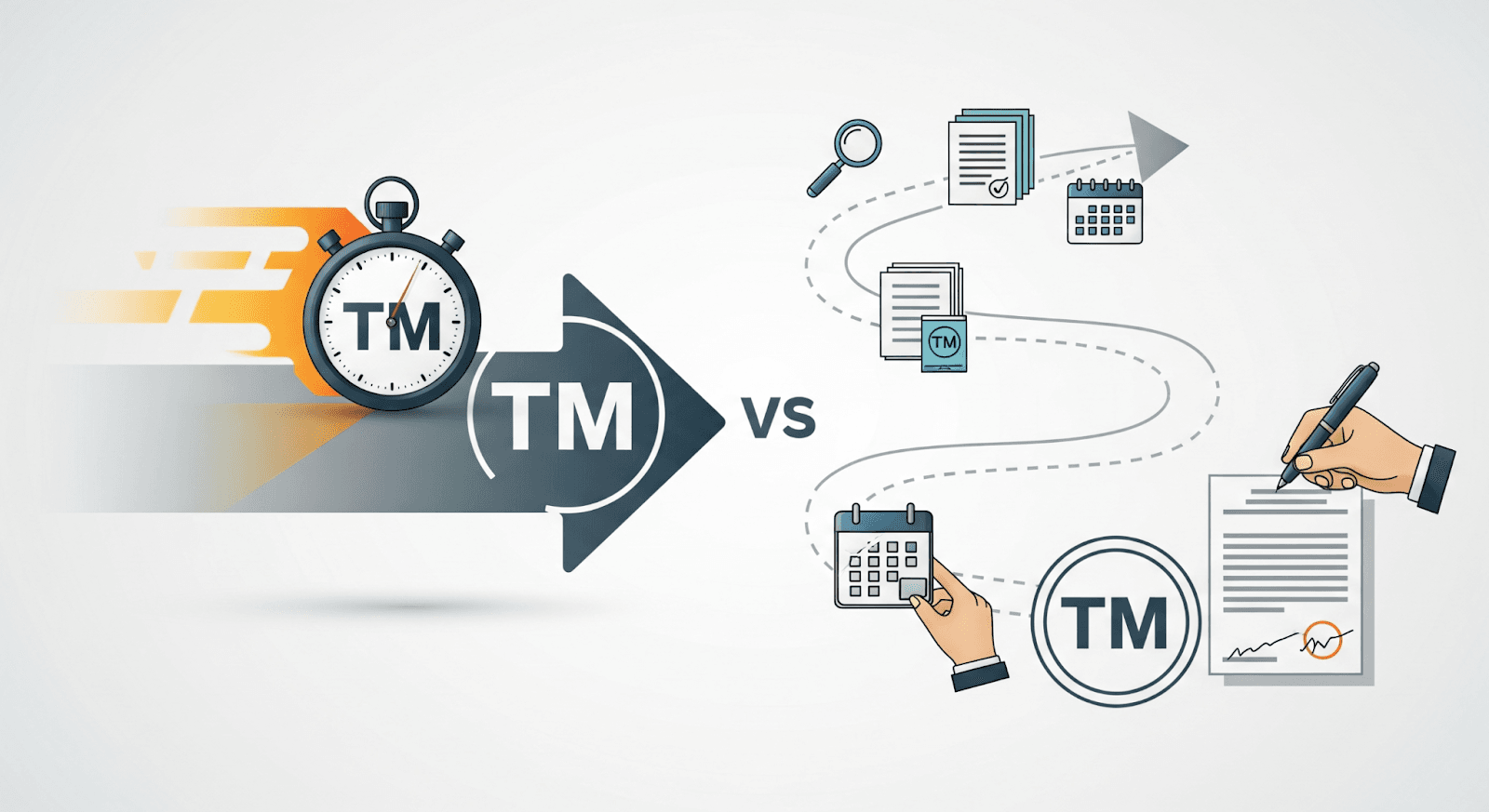
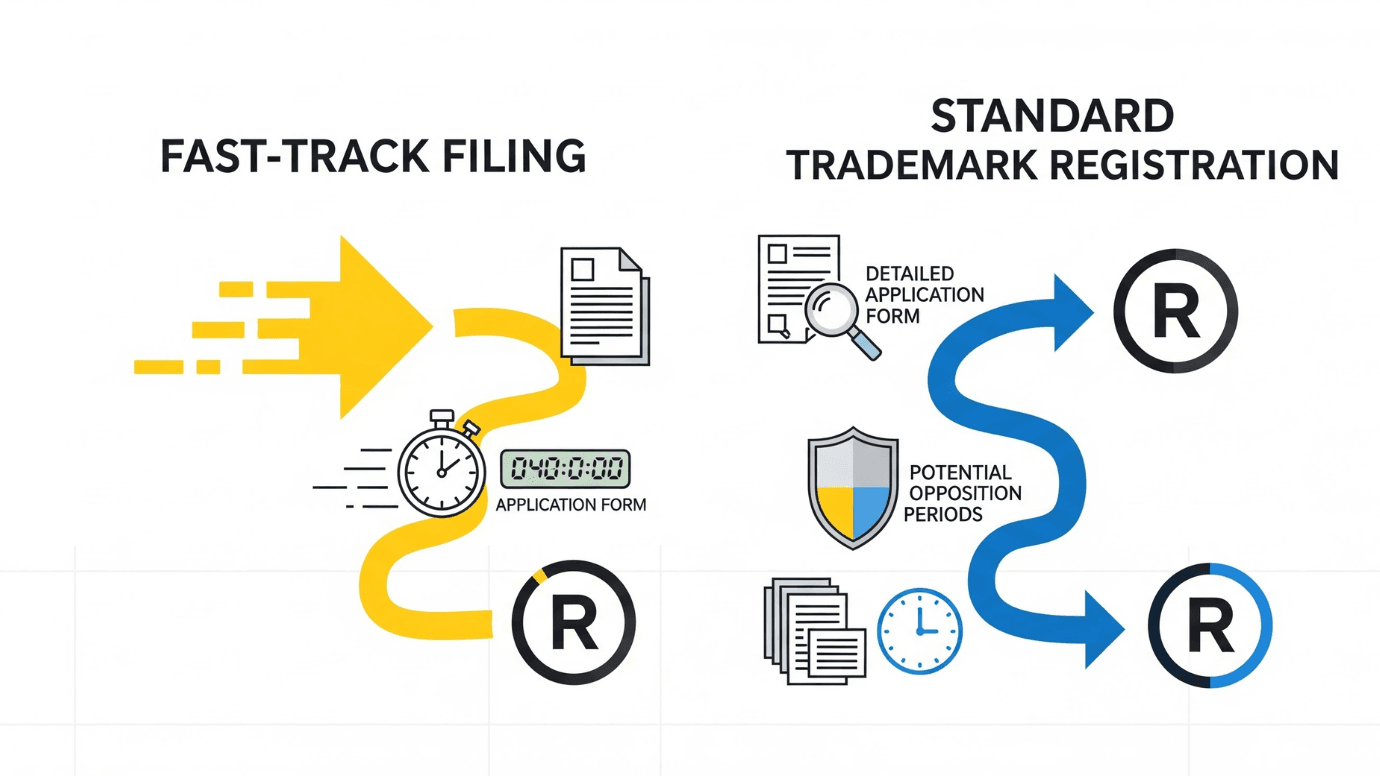
Standard paths follow USPTO rules with set wait times. On the other hand, Fast-track is often marketed as a way to move faster. These services speed up paperwork, yet government review stays the same. In the United States, it usually means faster preparation and faster submission, not a faster government examination. USPTO examination follows published queues, but also has only limited exceptions.
To file quickly with fewer errors, it is better to start with Trademark Registration so the filing work and package options are clear from day one.
Define “Fast-Track” vs. “Standard” Filing
Fast-track language is used loosely, so this makes it essential for you to have a clean definitions of the comparison. Clear terms prevent false expectations and also play a vital role in protecting budgets. The difference between “fast” and “effective” is often the difference between filing speed and registration certainty.
Standard Trademark Registration
Standard filing is the normal USPTO pipeline. The application is examined based on legal requirements and the filing basis. In this, the filing basis covers use in commerce, intent-to-use, or other pathways. The timeline can change depending on whether proof of use is already available and whether refusals appear during examination.
Fast-Track Filing & What It Usually Means In The U.S.
This is where many “express” offers land. The difference between express and regular trademark registration services is usually internal. It includes faster intake, quicker drafting, and faster submission. That can shorten the time it takes to get a filing receipt, but it does not automatically change how quickly an examiner reviews the file.
A True Fast-Track Exists In Some Jurisdictions
With the help of the fast track, EUIPO cuts the wait to months. It helps you save time, efforts and money. For example, the EUIPO offers faster processing when the application uses pre-accepted goods/services terms, and fees are paid upfront, among other requirements.
This distinction matters when someone asks, can you fast-track a trademark. In the U.S., the “fast” part is usually the filing service.
Standard USPTO Trademark Process Timeline
Product launchers track every stage. The trademark application process timeline starts with your moves and ends with USPTO calls. A clean timeline plays a vital role in reducing panic when the status is pending.
Steps in the Trademark Registration Process
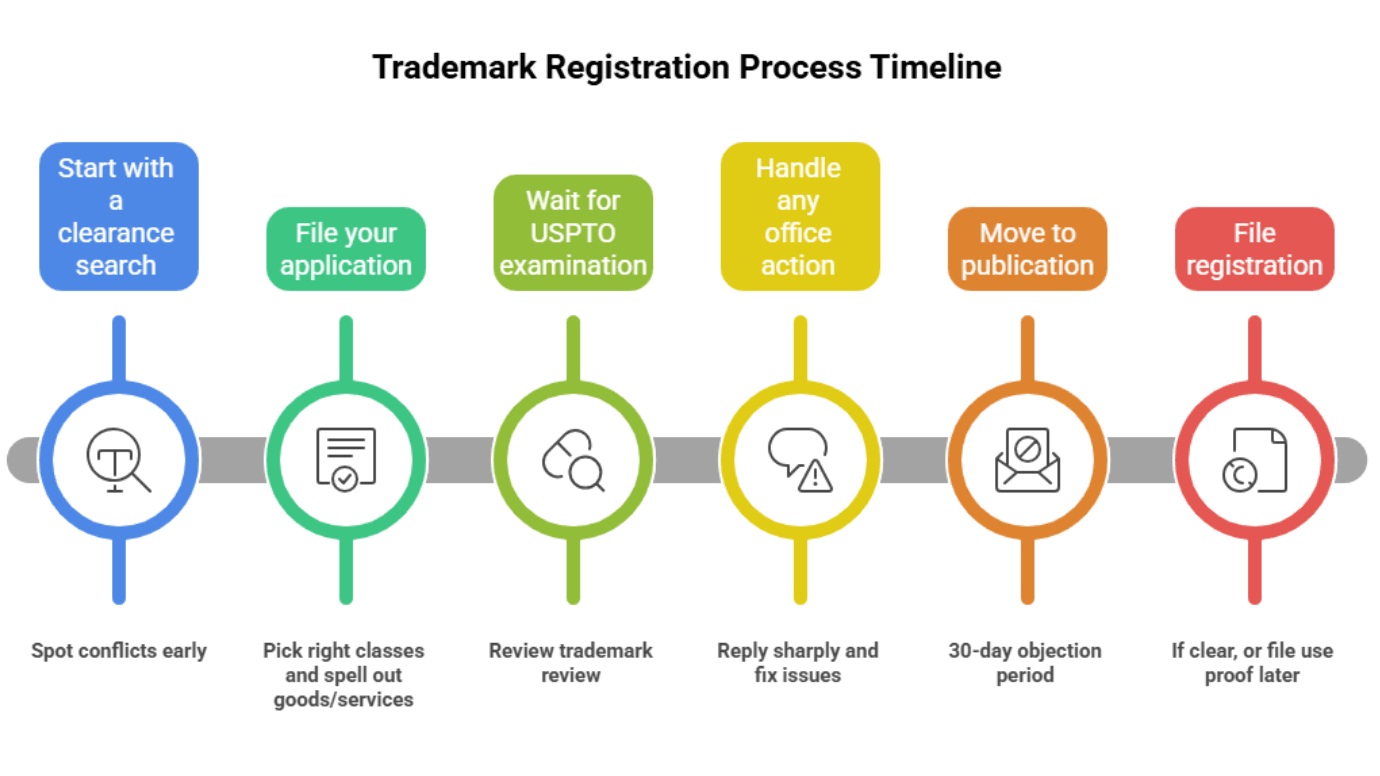
The sequence in the trademark registration process is simple, but each step carries risk. A small mistake early can add months later. This is why many delays are not “USPTO delays,” but applicant-made delays.
Steps in the trademark registration process often look like this:
- Start with a clearance search to spot conflicts early and dodge refusals down the road.
- File your application next and make sure to pick the right classes and spell out your goods or services clearly.
- Wait for the USPTO examination. Check their review of your trademark.
- Handle any office action that comes up by replying sharply. Also, make sure to fix what they flag to prevent further issues and delays.
- Move to publication, giving rivals 30 days to object if they dare.
- File registration, if all is clear, or for intent-to-use filings, grab that Notice of Allowance and file use proof later.
Want to nail the front end? Start with a comprehensive trademark search.
How Long Does a Trademark Filing Take?
Many people ask this as if filing and approval are the same. They are not.
The timeline has two clocks. One is the part controlled by the applicant, and the other is the part that is controlled by the USPTO.
The applicant clock shows how long it takes to prepare and submit a trademark filing. The time can be hours to days, depending on readiness. The USPTO clock defines how long it takes to reach first action and final outcome, usually measured in months.
Filing speed does not fully control the examination timeline once the application enters the USPTO system.
Fast-Track Filing Benefits and Limitations
Fast-track offers can be useful, but only when the business understands what the speed applies to. The best cases are launch-driven, where speed-to-file is a real business asset. The worst cases are rushed submissions that later create delays through errors, refusals, or added fees.
Benefits of Fast-Track Filing From Speed-to-File
Fast-track filing typically improves speed-to-file. It may include rapid intake, faster classification help, and faster submission. It can also reduce self-inflicted delays when the application is built carefully using accepted practices, such as cleaner goods/services descriptions and complete information.
This directly serves urgent filers, packaging print deadlines, ads, influencers, distributors, and marketplace listing plans.
Limitations of Fast-Track Filing From Speed-to-Registration
Fast submission does not mean fast registration. A common question that people usually have is whether a same-day trademark filing can speed up the USPTO review process. In most cases, the answer to this is no. Many “express” offers stop helping once the USPTO queue begins. This is where expectations of “same-day filing” usually break.
The USPTO still examines applications. It examines them based on its workflow and published averages. The average time to first action is 4.5 months. So, while people search for different ways to expedite trademark registration, ordinary applications generally do not have a routine pay-to-skip lane.
Comparison in Terms of Speed, Cost, Certainty
Decision-making improves when speed, cost, and certainty are separated. Some types of filings need speed, while others need certainty. Many need both, but trade-offs still exist. The goal is to pick the right path and make sure that it matches the risk tolerance of the launch.
Fast-Track V.s. Standard Process
| Dimension | Fast-track filing | Standard filing |
|---|---|---|
| Speed | Faster submission and unchanged USPTO timing. | Slower submission; same USPTO queue. |
| Cost | USPTO fee still applies; service “rush” fees vary. | USPTO fee still applies; fewer service extras. |
| Certainty | It can improve if it forces better inputs; it can hurt if rushed and sloppy. | Can improve with planning and thorough clearance. |
| Best use-case | Fixed launch dates; urgent filers; fast-moving e-commerce. | Early-stage brands still testing names. |
Note: On government fees, the USPTO lists a base application filing fee of $350 per class if the application meets the requirements. The USPTO also lists additional fees that can apply when required information is missing or when free-form descriptions are used instead of ID Manual selections, which is $200 per class. Those extras can raise costs and slow review, one reason rushed filings can backfire.
Take a look at Trademark Engine's registration packages to bundle fees and skip extras.
Risks Of Rushing: Where Fast-Track Can Backfire
Fast-track can reduce delays when it improves quality. It can also create delays when it reduces quality. The difference is often in small details that are hard to fix later. Rushed means preventable problems that turn into examination issues and extra fees.
Common Failure Points
Some problems are hard to fix once filed. Others can be fixed, but only with time, fees, and careful responses. The most painful delays are often avoidable.
Common failure points include wrong owner details and unclear goods/services wording. It also includes specimen issues. These can trigger requirements or refusals, and they can extend the timeline. Another major issue is conflict with existing marks. The USPTO explains that an examining attorney may refuse registration for the likelihood of confusion with a registered mark for related goods or services.
These are also frequent reasons for trademark application denial, which affects the perceived likelihood of trademark application success.
How to Speed Up a Trademark Application
The safest “speed” strategy is not skipping steps. It is removing the friction that causes preventable delays. The USPTO explicitly points to choices that can prevent processing delays, especially around how goods/services are described and whether the application includes required information.
USPTO-Aligned Acceleration Checklist
If you want to know how to speed up trademark application and ways to expedite trademark registration, focus on these practical moves:
- Use accepted identification practices; avoid free-form text when possible because it can take longer to review and may trigger extra fees.
- File complete information at the start to avoid “insufficient information” charges and rework.
- Reply to USPTO notices quickly and accurately to prevent abandonment risk.
For the fastest trademark filing options for small business owners on a budget, the goal is not just a quick click-through. It is avoiding mistakes that cause re-filing, delays, or extra fees.
A light first step for screening is a direct-match check. A practical entry point is Free Trademark Search before committing to a full filing plan.
TM vs ®, and Trademark vs Copyright
Launch teams often confuse what they can claim today and what they can claim after registration. This confusion leads to risky labeling and a weak enforcement posture. It also causes unclear messaging.
When to Use TM Symbol vs R Symbol
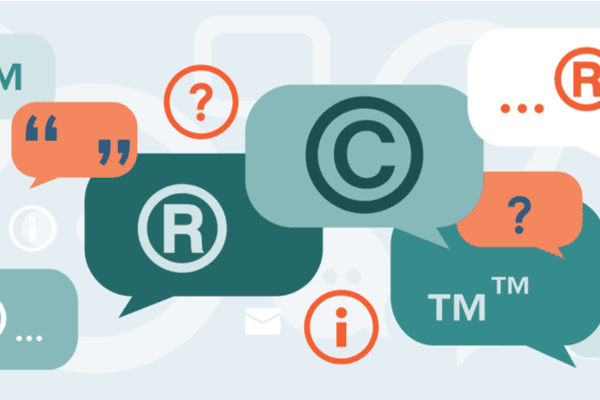
TM and SM are claim signals. ® is a registration signal, and it has rules. When you use the wrong symbol, it creates avoidable problems. The USPTO explains that “TM” for goods and “SM” for services can be used even if an application has not been filed. Once the trademark is registered, the ® symbol may be used, and only for the goods or services listed in the federal registration.
What It All Means
Fast-track filing improves speed-to-file and can improve quality control when it prevents avoidable errors. Standard processing still depends on USPTO queues and legal review. It gives your brand a quick jump out of the gate. Along with this, the real race runs on USPTO rails.
Panning to start with the path that will match your business goal? Use Trademark Engine's Trademark Registration for filing support and package options.
FAQs
How long does it take to get a trademark?
For current averages, the USPTO reported about 4.5 months to first examining action and about 10.2 months to registration or abandonment (updated Jan 31, 2026).
Does same-day trademark filing speed up the USPTO review process?
Same-day filing speeds up submission, but USPTO review follows published queues and workflow timing.
Can you pay to expedite a trademark application?
Petitions exist for limited situations. Also, there is no routine “pay to jump the line” method for ordinary applications.
Why is my trademark pending?
“Pending” can mean the USPTO has not reached the file yet. It can also mean the file is moving through stages like examination or publication. A pending status is common, not automatically bad. After filing, the USPTO assigns a serial number. Along with this, an examining attorney reviews the application for legal requirements and registrability.
Can I use my trademark while it’s pending?
Businesses commonly use TM (or SM for services) to signal a claim, but ® is only for federally registered marks.
Trademarket Blog
Everything you need to know about starting your business.
Each and every one of our customers is assigned a personal Business Specialist. You have their direct phone number and email. Have questions? Just call your personal Business Specialist. No need to wait in a pool of phone calls.